Strategic criteria, platform-by-platform auditing—from TV, radio, and print to digital, OOH, indoors, sponsorships, and product placement—and an evaluation matrix to select a media partner that protects your investment.
Strategic criteria, platform-by-platform auditing—from TV, radio, and print to digital, OOH, indoors, sponsorships, and product placement—and an evaluation matrix to select a media partner that protects your investment.
Choosing a media agency based on discount percentages or holding-company prestige usually leads to rigid plans, misallocated budgets, and metrics disconnected from commercial reality. Today, your budget competes for attention across a fragmented ecosystem where connected TV, digital audio, programmatic outdoor media, print, indoor circuits, and live activations coexist.
This guide is built for marketing directors, general managers, procurement leads, and commercial leaders at B2B and B2C companies who need to select or audit a media agency. Below, you will find the critical factors to evaluate before signing a contract, what to demand across every advertising platform, and how to structure a transparent selection process driven by business outcomes.
Why choosing the right media agency defines your investment’s profitability
The role of a media agency is no longer limited to buying ad space in bulk. According to WARC Media’s Global Ad Spend Forecast Q3 2026, global advertising investment will reach $1.34 trillion in 2026 (up 11.9% year over year), with social media, search, and retail media accounting for 66.4% of global spend. Similarly, WPP Media’s This Year Next Year 2026 report projects the market will surpass $1.3 trillion, propelled by digital expansion and generative search.
This concentration in major digital platforms does not eliminate the value of mass media or physical formats, but it fundamentally changes how they must be orchestrated. Buying each channel in silos—digital with one vendor, TV or radio with another, and outdoor with a third—duplicates frequency, inflates cost per effective reach, and fragments your brand message.
A competent media agency acts as an audience architect: it translates your commercial goals into an integrated plan where every medium serves a specific function across the conversion funnel, from mass awareness to demand capture and retention.
- What to verify: Whether the agency understands your business model, margins, commercial seasonality, and sales cycle before discussing rates or media packages.
- Red flag: Proposals that recycle the same channel mix for every advertiser without questioning your target audience or operational capacity to handle demand.
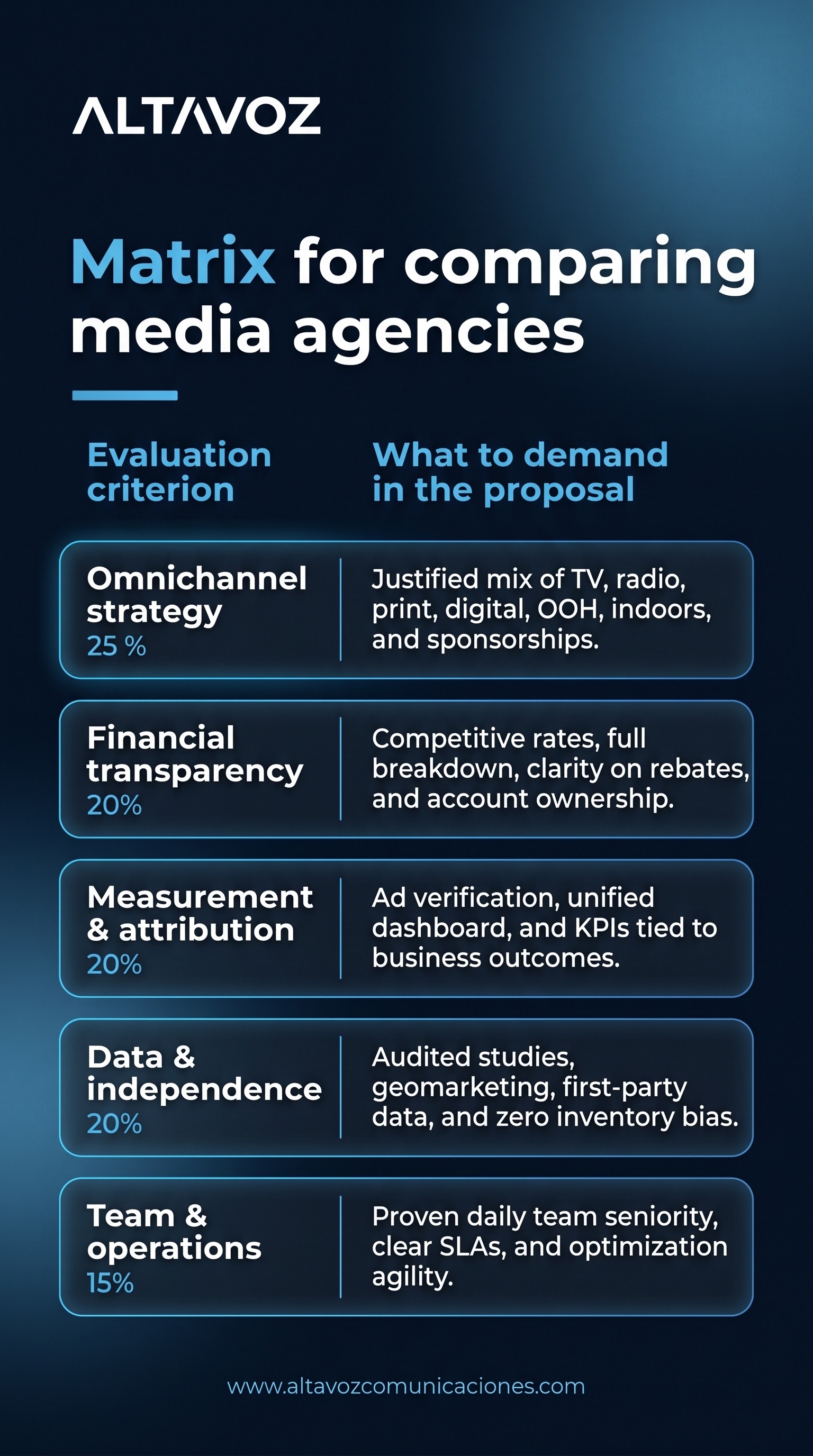
1. True mastery of the omnichannel ecosystem: what to demand by platform
A full-service media agency must demonstrate technical rigor and negotiating leverage across the entire media spectrum. Excelling only in paid social or holding strong TV deals is not enough; the right partner knows when to blend traditional, digital, and non-conventional channels based on your budget and business goal.
Broadcast TV, pay TV, and Connected TV (CTV)
Television remains a powerful engine for mass reach, prestige, and emotional storytelling through sight and sound. However, viewing habits have shifted toward on-demand video and Connected TV (CTV), whose global growth WARC projects will exceed 15% in 2026. Your agency must balance linear TV coverage in prime dayparts with the household and geographic targeting of CTV, avoiding wasted spend on audiences that no longer watch traditional broadcasts.
Traditional radio and digital audio
Radio stands out for high frequency, cost efficiency, local proximity, and strong affinity with audiences segmented by format or time slot. While WARC projects a slight contraction in traditional radio (-1.9% in 2026), digital audio (podcasts and streaming platforms) is growing close to 10%. An up-to-date agency combines live host reads and radio spots with geolocated programmatic audio to reach your audience during daily commutes and screen-free moments.
Newspapers and digital press
Newspapers—both print editions and digital portals—deliver editorial credibility, informational depth, and direct access to decision-makers. In B2B, corporate, or reputation-focused campaigns, editorial context matters as much as reach. Demand that the agency evaluate true readership affinity, avoid intrusive ad clutter, and negotiate high-impact placements or sponsored content with editorial rigor.
Trade and lifestyle magazines
Magazines offer psychographic and industry-specific segmentation that is difficult to replicate in mass media, alongside a longer shelf life and high-quality visual environments. They are particularly effective for luxury brands, B2B industrial sectors, architecture, healthcare, and finance. Your agency should justify print spend using audited circulation data, reader profiles, and synergy with the publisher’s digital editions.
Digital media (Search, Paid Social, Programmatic, and Retail Media)
The digital ecosystem enables granular targeting, real-time optimization, and direct conversion tracking. Yet it also carries risks of ad fraud, brand safety issues, and over-reliance on closed auctions. Your agency must master Google Ads, Meta, LinkedIn, TikTok, programmatic DSPs, and retail media—while guaranteeing full ownership of ad accounts under your company’s name and active management of first-party data.
Out-of-home advertising: OOH and DOOH
Outdoor media (billboards, unipoles, bus shelters, and digital LED screens) reaches audiences during real-world commutes with zero possibility of ad-blocking or skipping. Your agency should plan using mobility data and geomarketing, balance the 100% Share of Voice of static OOH with the agility of DOOH, and connect physical placements to mobile retargeting via geofencing.
Indoor media (captive interior environments)
Indoor networks cover screens and displays inside shopping malls, airports, corporate towers, elevators, cinemas, gyms, and clinics. Their core advantage is extended dwell time and proximity to the point of decision or purchase. A capable agency segments these spaces by socioeconomic profile, corporate density, or leisure occasion, integrating them with point-of-sale activations.
Event sponsorships, trade shows, and cultural or sports properties
Sponsorships align your brand with high-value territories, foster executive-level public relations, and capture qualified leads in live environments. Your agency should not stop at negotiating a logo on a backdrop: it must audit real attendance, secure activation rights, lead-capture opportunities, press mentions, and digital amplification before, during, and after the event.
Product placement and Branded Content
Integrating your product or service organically into TV shows, streaming series, podcasts, digital productions, or live events bypasses natural viewer resistance to commercial breaks. Here, the agency must collaborate closely with producers and creative teams to ensure the integration feels natural, is measurable in screen time, and aligns with your brand positioning.
- What to ask for: Recent case studies and verifiable credentials across at least the four or five priority channels for your industry, detailing the exact role each medium played in the final outcome.
- Red flag: Agencies that try to steer your entire budget into a single channel (e.g., digital-only or TV-only) simply because it is where they have internal headcount or higher margins.

2. Audience-first planning, data rigor, and inventory independence
A modern media agency does not plan by buying isolated ad slots; it builds audience maps. Before deciding whether you need TV, radio, indoors, or programmatic, the agency must cross-reference your internal business data (customer profiles, top-performing sales zones, historical revenue, and competitor footprint) with syndicated media consumption studies and audience intelligence platforms.
Independence is equally critical. Many agencies hold annual volume commitments with specific media conglomerates or concessionaires. If those deals bias technical recommendations, you will end up funding channels that serve the agency’s rebate quota rather than your commercial growth.
- What to verify: Which audience research and planning tools the agency uses (TV/radio ratings, digital panels, geomarketing, social listening) and whether its recommendations remain strictly agnostic to media owners.
- Red flag: Media plans that fail to explain combined cross-channel reach and frequency, or show a suspicious concentration of spend within a single media group.
3. Financial transparency, negotiating leverage, and remuneration models
Commercial opacity is the leading source of friction between advertisers and media agencies. By pooling large volumes, a strong agency should pass along preferential rates, bonus inventory, and priority access during peak seasons. However, that buying power only benefits you if the financial framework is fully auditable.
Before signing, define the remuneration model clearly:
- Fixed monthly fee: Predictable and tied to dedicated team hours; removes the agency’s incentive to inflate your media budget.
- Percentage of media spend: Commission applied to total media investment; requires strict governance to prevent recommendations aimed solely at increasing spend.
- Hybrid model with performance bonuses: Combines a base fee with incentives tied to verifiable business KPIs.
You must also demand complete clarity on volume rebates or kickbacks granted by media owners to agencies, ad-tech fees, production markups, and ownership of digital accounts.
- What to ask for: A contract with a financial transparency clause, the right to audit original media vendor invoices, and full administrative ownership of your Google, Meta, LinkedIn, and DSP accounts.
- Red flag: Pushback against sharing itemized vendor invoices, refusal to grant admin ownership of your ad accounts, or "too-good-to-be-true" discounts lacking real inventory backing.
4. Unified measurement, ad verification, and cross-media attribution
Investing across ten different platforms without a shared measurement framework turns your budget into a black box. Each medium uses its own currency (GRPs in TV, reach and frequency in radio, impressions and CPM in OOH, clicks and CPA in digital), but executive leadership needs business answers.
A rigorous media agency structures measurement across three tiers:
- Ad verification: Broadcast certificates for TV and radio, press monitoring clippings, dated photographic audits or playlogs for OOH/DOOH and indoors, plus viewability and brand safety verification in digital.
- Channel performance: Cost efficiency (CPM, CPC, CPL, cost per GRP), net reach, and effective frequency.
- Business contribution: Cross-media attribution models, Brand Lift studies, organic brand search lift, foot-traffic analysis, Marketing Mix Modeling (MMM), and CRM integration.
- What to ask for: A real example of an executive dashboard integrating traditional, outdoor, and digital media, along with reporting cadence and optimization meeting schedules.
- Red flag: Monthly reports built as basic screenshots or summed "total impressions" that ignore impact quality and fail to connect media spend to leads or revenue.
5. Account governance, assigned team, and operational agility
One of the most common pitfalls when hiring large agencies is the "pitch-and-switch" effect: a senior team presents a sharp strategy to win the account, but once the contract is signed, day-to-day execution is handed off to overloaded junior staff managing dozens of clients.
Evaluate who will actually run your account daily: who plans, who negotiates with media owners, who optimizes digital campaigns weekly, and who responds when the unexpected happens (such as a missed broadcast, a reputational crisis requiring an immediate ad pause, or a sudden commercial shift).
- What to verify: The exact structure and seniority of your assigned team, the average number of accounts each executive manages, and clear Service Level Agreements (SLAs) for urgent changes.
- Red flag: Agencies that do not introduce the operational team during the selection process or take days to execute tactical adjustments.

Common mistakes when choosing a media agency
- Choosing solely based on the lowest agency fee: An artificially low commission is often offset by hidden media markups or inexperienced teams that waste your budget.
- Evaluating each platform in isolation: Buying TV, OOH, sponsorships, and paid digital without a unified strategy prevents synergy measurement and produces contradictory messaging.
- Failing to define business KPIs before the pitch: If your brief only asks for "more reach," you will receive proposals optimized for cheap volume rather than purchase-ready audiences.
- Surrendering ownership of digital accounts and data: If you switch agencies later and the ad accounts belong to the agency, you lose your historical learning and audience assets.
- Ignoring real offline lead times: Unlike digital, TV, print, OOH, indoors, and product placement require booking, production, and approval windows that must be planned well in advance.
- Excluding creative and sales teams from the process: Even the sharpest media plan fails if creative assets are not adapted to each format or if the sales team is unprepared to capture incoming demand.
Frequently asked questions about media agencies
What is the difference between a media agency and a full-service advertising agency?
A media agency specializes in audience research, strategic media planning, negotiation, buying, and measurement of ad placements. A full-service agency combines that capability with creative production, public relations, digital marketing, and editorial communications—ensuring message and channel operate under a single strategic direction.
At what budget level does it make sense to hire a media agency?
It makes sense once your company invests consistently across more than two channels (for example, digital plus radio, OOH, or TV), or when you need corporate rate negotiation, independent auditing, and relief for your internal team from managing multiple media vendors.
Can one media agency handle traditional media, digital channels, and special activations?
Yes, and it is usually the most efficient route. Centralizing TV, radio, print, digital, OOH, indoors, sponsorships, and product placement under one partner lets you control total frequency, negotiate integrated packages, and measure each channel’s true contribution in one dashboard.
How can you ensure a media agency is transparent with rates?
Include an explicit remuneration model in the contract, the right to audit direct media-owner invoices, a written policy on volume rebates, and full administrative ownership of all your digital ad platforms.
How often should you audit or evaluate your media agency?
Best practice is to hold monthly tactical reviews, quarterly strategic evaluations against business KPIs, and one comprehensive annual audit covering rates, SLA compliance, and return on investment.
Turn your media plan into a measurable competitive advantage
Choosing a media agency is not an administrative procurement task: it is deciding who will steward your brand’s visibility, financial efficiency, and growth across every touchpoint where your audience moves. When you prioritize omnichannel rigor, contractual transparency, verifiable data, and business-driven measurement, every dollar invested works with clear intent.
Are you planning to restructure your media investment or select a strategic partner that integrates your traditional, digital, and live channels?
At Altavoz Comunicaciones, we design and manage comprehensive strategies across advertising, media planning, digital marketing, public relations, and editorial communications with a focus on measurable outcomes. We partner with B2B and B2C companies across Peru, Mexico, Colombia, and Spain to turn communications spend into positioning, demand, and sustainable reputation.