Operational criteria, verifiable metrics, and the exact brief you need to select an out-of-home (OOH and DOOH) media agency that turns locations into measurable business results.
Buying outdoor advertising without clear technical criteria usually leads to the same outcome: paying for a list of available billboards no one audited, without knowing whether your actual audience passes by or what impact the investment generated. In an environment where digital saturation pushes users to block ads on their phones, Out of Home (OOH) media is regaining commercial relevance—but it demands the same buying rigor as any performance channel.
This guide is designed for marketing directors, commercial managers, and media leads at B2B and B2C companies who need to choose an OOH/DOOH media agency or buying hub. Below, you will find the key criteria to audit proposals, distinguish between traditional and programmatic buying, demand real measurement, and build a brief that lets you compare agencies by strategic capability rather than just the number of faces offered.
Why choosing the right OOH media agency defines your campaign’s ROI
OOH is no longer just a volume channel; it has become a system of moments, journeys, and contexts. According to projections from the World Out of Home Organization (WOO), digital out-of-home (DOOH) advertising reached 47% of global sector spend in 2025 and is projected to hit 49% in 2026, while in Latin America its share still hovers around 27.7%, opening a window of rapid growth and professionalization across the region. Meanwhile, WARC estimates that DOOH will grow 13.7% globally in 2026.
In markets like Spain, the InfoAdex 2026 Study reported that outdoor media reached 460.5 million euros in 2025, growing 6.7% year over year. Across Latin America, this momentum comes down to a practical reality: a billboard, bus shelter, or LED screen occupies shared public space—it cannot be skipped with a button or blocked with software.
However, inventory alone does not guarantee results. A high-traffic avenue can be completely irrelevant if the demographic profile, direction of travel, or timing does not match your commercial objective. The role of a strong OOH media agency is to translate your business goals—brand awareness, foot traffic, product launches, or consideration—into a defensible plan of audiences, formats, and locations.
- What to verify: Whether the agency starts from your business objectives and target audience before showing you available spaces, or if it simply tries to sell pre-packaged inventory.
- Red flag: Proposals that only list locations and prices without justifying why each site aligns with your potential customers’ actual daily routes.
1. Geomarketing capabilities, mobility data, and location intelligence
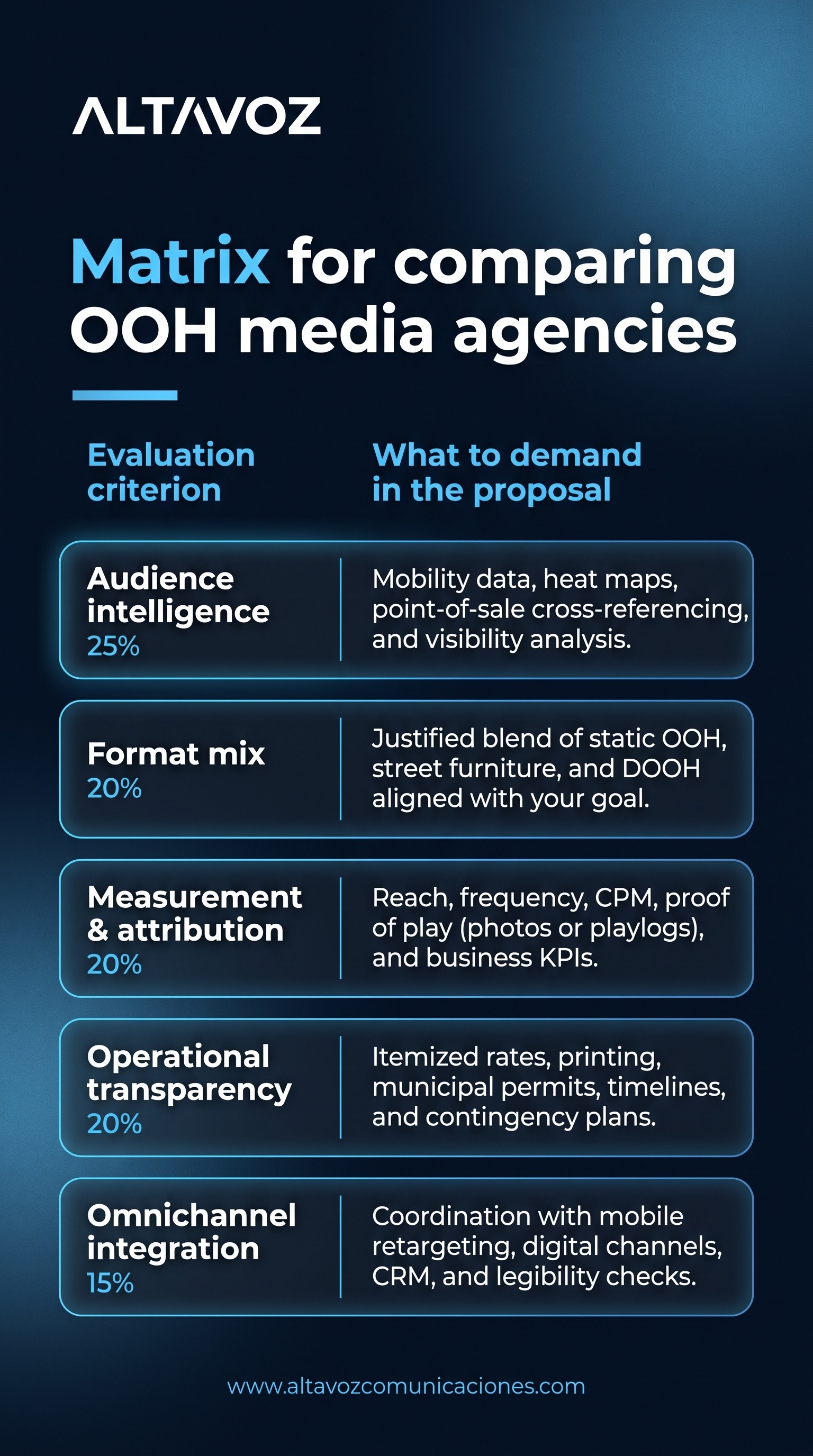
The first filter for evaluating an OOH media agency is its access to mobility data and geospatial intelligence (GIS) tools. Planning by intuition or by the reputation of a major avenue is no longer enough. A competent agency cross-references your internal business data—store locations, top-performing sales zones, competitor presence, and catchment areas—with real pedestrian and vehicular traffic data.
To achieve this, specialized agencies rely on heat maps based on affinity indices, daily commuting patterns, and official or audited audience sources (such as Geomex in Spain or mobile geolocation platforms in Latin America). This identifies where your audience concentrates, at what times they commute, and whether they travel by public transit or private vehicle.
Location analysis must also account for physical variables that affect readability: travel speed, viewing angle, urban obstructions (trees, wiring, overpasses), nighttime lighting, and actual dwell time. A poorly oriented billboard loses much of its value regardless of how much traffic the road records.
- What to ask for: A heat map or mobility rationale explaining daily pedestrian and vehicular traffic for each proposed zone, along with the data source, measurement period, and methodological assumptions.
- Red flag: "Impression" or "impact" figures delivered without methodology, verifiable sources, or transparent calculations—making it impossible to compare providers objectively.
2. Mastery of the format mix: static OOH, DOOH, and programmatic buying (pDOOH)
No single outdoor format is universally superior; each medium serves a different role depending on the behavior you want to drive. A solid OOH media agency does not depend on one type of inventory—it combines static, digital, and transit formats based on your reach, frequency, or proximity goals.
- Large-format static (unipoles, spectaculars, highway billboards, and building wraps): Ideal for building brand awareness and mass coverage. Their main advantage is 100% Share of Voice (SOV), as only your brand occupies the space for the entire contracted period, typically a minimum of four weeks.
- Street furniture (MUPIs, bus shelters, and pedestrian totems): Positioned at eye level, these formats excel at driving frequency, recall, and traffic to nearby locations. According to IAB’s Annual DOOH Study, bus shelters lead outdoor ad recall at 61%, followed by urban transit at 58.9%.
- Digital Out of Home (DOOH) and programmatic (pDOOH): LED screens on major avenues, shopping malls, airports, and corporate buildings. They allow exact start dates, multiple message rotations with zero printing costs, and creative adaptation based on time of day, weather, or crowd density.
When evaluating DOOH or pDOOH buying through Demand-Side Platforms (DSPs), review the balance between flexibility and screen time. Because screens rotate multiple advertisers, an overly low SOV reduces memorability. Also distinguish between guaranteed buys (secured slots within the loop) and non-guaranteed buys (remnant inventory subject to availability).
- What to verify: For DOOH, request in writing the spot duration, loop frequency, broadcast hours, Share of Voice (SOV), access to playlogs, and the make-good policy for technical outages.
- Red flag: Agencies recommending DOOH for hyperlocal campaigns in areas with limited screen coverage, or selling non-guaranteed programmatic buys without warning you about under-delivery risks.
3. Measurement, verification, and attribution without mixing concepts
One of the costliest mistakes in outdoor advertising is accepting reports that blend incompatible metrics. A rigorous OOH media agency clearly separates three complementary layers:
- Audience measurement: Estimates potential exposure, reach, average frequency, and cost per thousand impressions (CPM).
- Verification (Proof of Play): Confirms through dated photographic audits (for static OOH) or certified playlogs (for DOOH) that your ad was installed, illuminated, and active throughout the contracted period.
- Business attribution: Analyzes the relationship between outdoor exposure and subsequent behavior, such as physical store visits, brand search lift, web traffic, or lead generation.
To connect OOH with measurable commercial outcomes, the agency should propose primary and secondary KPIs from the start. This includes short URLs, trackable QR codes, dedicated phone numbers, pre- and post-campaign brand lift surveys, geolocated search analysis, and lead tagging in your CRM. If the chosen methodology only demonstrates correlation rather than direct causation, the agency must report it transparently.
- What to ask for: The final reporting template before signing a contract, including baseline metrics, measurement windows, photo proof or playlogs, and secondary KPIs tied to your business goals.
- Red flag: Providers that only promise "brand presence" or "millions of impacts" without offering proof-of-play verification or digital/commercial lift metrics.
4. Commercial transparency, negotiation, and operational management
Outdoor advertising involves logistical complexities that do not exist in digital media. An experienced media agency absorbs that operational friction and gives you financial clarity from the initial quote.
When comparing budgets, make sure all costs are itemized: media space rate, vinyl or banner printing, color proofs, installation, takedown, nighttime illumination, and valid municipal permits. For static formats, remember that launch dates are usually managed by installation week and require production lead times; a reliable agency aligns that schedule to prevent delays during seasonal launches.
Another critical factor is negotiation independence. Ask whether the agency works with multiple local and national media owners or is tied to a single concessionaire. Partnering with an independent agency lets you combine the scale of major operators with the flexibility and cost efficiency of local providers.
- What to verify: Full rate breakdown (media vs. production vs. agency fees), municipal permit validity for all sites, and replacement clauses if a location becomes obstructed or damaged.
- Red flag: Lump-sum quotes without production breakdowns, unclear responsibility for reprinting costs in case of defects, or unrealistic installation timelines.
5. Omnichannel integration and readable creative advisory
OOH multiplies its performance when coordinated with your digital channels and sales team. Advanced strategies use digital geofencing around outdoor placements to serve mobile retargeting ads to people who passed by your billboard, reinforcing the message and boosting recall.
Likewise, the agency should advise you on outdoor legibility rules. A roadside billboard or avenue screen is not an enlarged social media post: audiences have two to five seconds to process the message while moving. Creative assets require high contrast, clean large typography, one dominant visual, minimal copy, and an effortless call to action. Every format family requires adaptation; visual consistency does not mean forcing the exact same layout onto a horizontal billboard and a vertical street-level MUPI.
- What to ask for: Format-specific creative adaptation guidelines (viewing distance, screen brightness, transitions) and a synchronization plan with your search, social, and CRM campaigns.
- Red flag: Agencies that accept any final artwork without reviewing legibility at scale or fail to coordinate the outdoor calendar with the rest of your media plan.

Common mistakes when choosing an outdoor advertising agency
- Deciding solely on the lowest price or highest number of faces: A cheap package in secondary or poorly oriented locations ends up costing far more per effective impression than a data-curated circuit.
- Confusing a media owner with a strategic agency: A billboard operator will sell you its own available inventory; a media agency evaluates the entire market and selects the sites that best serve your audience.
- Ignoring Share of Voice (SOV) on digital screens: Buying DOOH with an overly low rotation dilutes frequency and sharply reduces brand recall.
- Leaving measurement until the end of the campaign: If you do not define your baseline, QR codes, tracking URLs, or recall surveys in the brief, you will not be able to prove ROI to leadership.
- Reusing digital assets without adapting them for outdoor viewing: Long copy, thin fonts, or cluttered visuals make an ad unreadable at vehicular speeds.
- Launching without aligning the commercial team: If your OOH campaign drives spikes in brand searches, calls, or store visits, your sales team and digital channels must be ready to capture that demand.
Frequently asked questions about OOH media agencies
What is the difference between an OOH media agency and an outdoor media owner?
A media owner (or operator) owns specific structures—billboards, shelters, or screens—and sells its own inventory. An OOH media agency acts as a strategic partner: it analyzes your audience, negotiates with multiple operators simultaneously, designs the optimal format mix, and audits execution and results.
What is the minimum duration for an outdoor advertising campaign?
For traditional static formats, the market standard is a minimum of four weeks due to production and installation costs, though six- to eight-week flights improve message retention. Digital formats (DOOH) offer greater flexibility and can be activated for as little as one week or specific dayparts.
Does OOH advertising work for B2B companies and SMBs, or only for large consumer brands?
It works for both as long as there is a clear geographic objective. An SMB with physical locations can concentrate its budget on street furniture or billboards near its catchment area, while a B2B company can activate screens in financial districts, airports, or corporate corridors around major industry events.
How do you actually measure the ROI of an OOH campaign?
ROI is evaluated by combining exposure metrics (reach, frequency, and CPM) with commercial attribution indicators: organic brand search lift in impacted zones, traffic to dedicated landing pages via QR codes or short URLs, physical store footfall, and CRM-tagged leads.
Should you choose static OOH or digital screens (DOOH)?
It depends on the campaign’s role. Static OOH delivers 100% Share of Voice, broader suburban coverage, and strong hyperlocal presence. DOOH excels in launch agility, zero printing costs, and contextual messaging by time of day or weather. In most cases, combining both formats achieves the best balance between coverage and flexibility.
Turn outdoor media into a measurable growth channel for your business
Choosing an OOH media agency is not about buying empty spaces on the street—it is about ensuring your brand appears at the exact moment, route, and format where your audience makes decisions. When you demand mobility data, commercial transparency, proof of play, and digital integration, outdoor advertising stops being a vanity visibility expense and becomes a real lever for growth.
Are you planning to launch or restructure an outdoor advertising campaign and need a strategy fully integrated with your digital and communications channels?
At Altavoz Comunicaciones, we design and execute comprehensive strategies that connect advertising, digital marketing, public relations, and editorial communications with a focus on measurable outcomes. We support corporate and expanding brands across Peru, Mexico, Colombia, and Spain—from diagnostic audits and media planning to creative adaptation and impact measurement.