
Understand how specialized media agencies operate, which pricing models they use, and what criteria you should evaluate before delegating your digital and traditional advertising budget.
Investing in advertising without a structured media strategy often leads to fragmented budgets, duplicated audiences, and vanity metrics that fail to move the bottom line. In an ecosystem where broadcast TV, out-of-home (OOH), radio, social media, search engines, streaming video, and programmatic buying all compete for attention, deciding where to allocate every dollar has become a demanding technical and financial discipline.
This guide is built for marketing managers, commercial directors, and general managers operating in Peru who want to professionalize their paid media operations. Below, you will find what a media buying agency actually does, how it differs from a creative agency, how fee structures work, and how to decide if your company needs one today.
What a media buying agency is and how it differs from media planning and creative agencies
A media buying agency is a specialized firm that plans, negotiates, purchases, audits, and optimizes advertising space across digital and traditional channels on behalf of an advertiser. Its core mandate is to place your message in front of the right target audience, at the right time, and at the most efficient cost to maximize return on investment.
In the Peruvian market, this specialization is increasingly critical. According to CPI Research's Market Report No. 002 on Advertising Investment (March 2026), total ad spend in Peru reached US$ 612 million in 2025, with digital channels capturing 37.4% (US$ 229 million), outpacing television (32%, US$ 196 million), radio (10%), and out-of-home advertising (9.8%). Meanwhile, the 2025 Digital Advertising Investment Report in Peru by IAB Peru and PwC (March 2026) highlights that digital ad spend totaled US$ 327 million (+12% year over year), with 82% concentrated on mobile devices and 17% transacted through programmatic buying.
To manage this landscape effectively, it helps to separate three functions that are frequently blurred:
- Media planning: defines the strategy before a single dollar is spent. It determines who to reach, what role each channel plays, how to split the budget, and when campaigns should run.
- Media buying: executes that plan in the market. It handles rate and added-value negotiations with publishers and platforms, issues insertion orders (IOs), oversees trafficking, and optimizes live campaigns.
- Creative agency: develops the campaign concept, messaging, and visual or audiovisual assets, but does not necessarily operate a media buying desk or inventory auditing stack.
Today, the strongest operations combine planning and buying under one roof. When the team negotiating and optimizing live placements understands the strategic rationale behind the plan, real-time adjustments protect business objectives rather than chasing cheap clicks.
What to verify: confirm whether the agency you are evaluating integrates strategic planning and media buying within the same team, or if it only executes tactical buys based on a plan you must build yourself.
Red flag: be cautious if a pitch starts by recommending specific channels or pre-bundled packages before analyzing your gross margins, target audience, and conversion funnel.
What a media buying agency actually does day to day
A media buying agency's job does not end when a campaign goes live; launch is where the real work begins. A professional operation covers five core functions:
- Audience and media consumption research: analyzes demographic, geographic, and behavioral data to identify where your target audience actually spends time—whether across Lima Metropolitana, priority regional markets, or B2B niches segmented by industry and job function. This prevents wasting spend on platforms where your buyers do not make decisions.
- Channel mix design and budget allocation: assigns a specific role to each channel based on your objective. A product launch calls for broad reach and awareness (TV, OOH, online video, or Connected TV), whereas qualified demand generation prioritizes paid search, retargeting, and tightly defined audiences on social platforms or LinkedIn.
- Inventory negotiation and procurement: leverages aggregated spend volume and direct relationships with traditional outlets and digital publishers to secure stronger rates, preferred placements, real added value, and makegoods when a media vendor fails to deliver promised reach or ratings.
- Trafficking, quality assurance (QA), and brand safety: configures technical parameters, checks creative specs, implements tracking pixels and conversion tags, and vets inventory quality. In digital environments, this includes filtering out bot traffic, excluding made-for-advertising (MFA) sites, and ensuring your brand does not appear next to unsafe or off-brand content.
- Ongoing optimization and actionable reporting: reviews performance daily or weekly, pauses underperforming placements, scales winning creative, and reallocates budget across channels. Strong reporting is not a dump of raw impressions; it answers what happened, what was learned, and what will change next week.
How to apply it: require a shared dashboard from day one that ties media metrics (reach, frequency, CPC, CPM) directly to business outcomes such as cost per qualified lead, customer acquisition cost (CAC), or return on ad spend (ROAS).
Mistake to avoid: judging campaign success solely by the lowest cost per click. Cheap traffic that fails to convert—or comes from low-quality inventory—inflates your true acquisition cost.
Buying models and fee structures: how to know if your budget is working for you
Not all advertising inventory is purchased the same way. Depending on your goals and required level of control, a media buying agency will combine three approaches:
- Direct media buying: upfront negotiation directly with TV networks, radio stations, OOH operators, or premium digital publishers. It provides predictability, exclusivity, and strict environmental control.
- Programmatic media buying: automated purchasing of digital inventory in milliseconds through demand-side platforms (DSPs) and real-time bidding (RTB). It enables data-driven audience targeting and rapid scaling.
- Hybrid media buying: secures high-visibility, brand-safe placements through direct deals while expanding reach and personalization via programmatic platforms and self-service channels like Google Ads or Meta Ads.
On the compensation side, the industry operates under three main structures: percentage of ad spend (typically 10% to 20% depending on volume), a flat monthly retainer, or a hybrid model combining a base fee with performance incentives.
Beyond the fee structure, contractual transparency is what protects your budget. You need clarity on whether the agency operates as an agent (buying in your company's name so you can audit actual publisher invoices) or as a principal (buying inventory at wholesale rates and reselling it to you with an undisclosed markup).
What to request before signing: ask for a clear line-by-line separation of net media spend, agency fees, and creative production costs. Ensure your contract explicitly states that all ad accounts, tracking pixels, and first-party audience data remain your company's property.
Red flag: if an agency insists on running campaigns from ad accounts it owns or refuses to share placement-level cost breakdowns, your company loses financial traceability and historical data if you ever decide to switch partners.
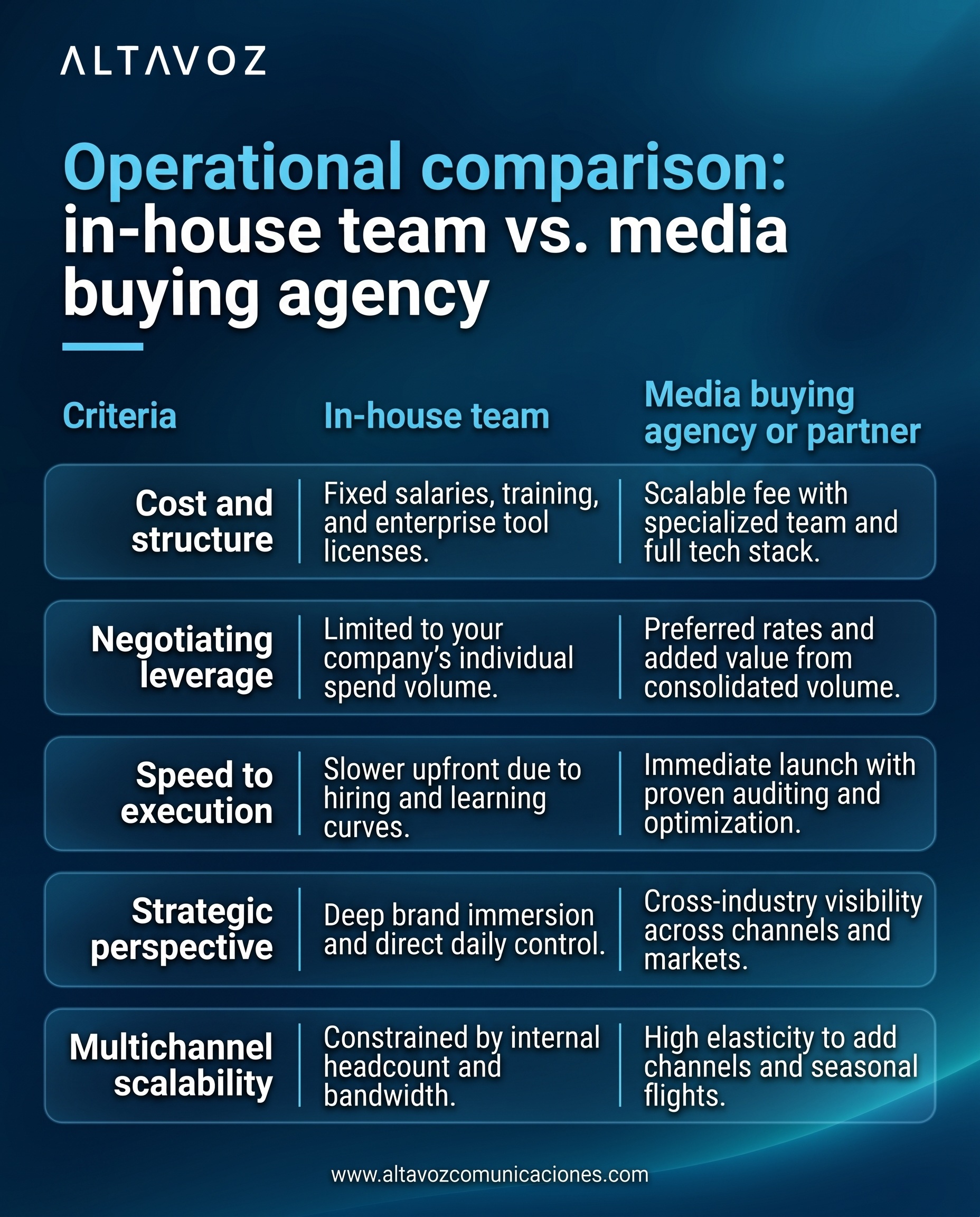
When to hire a media buying agency vs. managing media in-house
Outsourcing media buying makes financial sense when channel complexity or spend volume reaches a point where operational mistakes cost more than an agency fee. It is usually the right move if your company fits any of these scenarios:
- You invest across multiple channels simultaneously: coordinating mass media (TV, radio, OOH) alongside digital platforms requires managing multiple vendors, technical specs, and unified performance measurement.
- You face high-stakes seasonal peaks: in Peru, the second half of the year accounts for 55% of digital ad spend due to campaigns like Cyber events, Black Friday, and Christmas, according to IAB Peru and PwC. During those windows, auction competition spikes and daily optimization protects margin.
- Your internal team is stretched thin: working with dedicated buyers, planners, and analysts frees your marketing team to focus on commercial strategy, product, and brand—without carrying the fixed overhead of recruiting, training, and licensing tools for a full in-house desk.
Conversely, it is often better to hold off on hiring a full media buying agency if your monthly budget is very small (where a fixed retainer would eat up a disproportionate share of total spend), if you only advertise on a single straightforward digital platform, or if your website suffers from a weak conversion rate that needs conversion rate optimization (CRO) first.
How to decide: calculate what percentage of your total advertising budget the agency fee would represent. If it exceeds 20% to 25% of your monthly working media, consider starting with targeted consulting or a scoped hybrid setup before scaling.
Mistake to avoid: hiring a media buying agency expecting it to fix structural issues in your offer, pricing, or website experience. Strong media buying scales a funnel that already converts; it cannot repair a broken landing page.

Common mistakes when hiring or managing a media buying agency
- Confusing activity with business outcomes: signing off on reports packed with impressions and clicks without connecting spend to qualified leads, pipeline, or revenue.
- Accepting opaque bundled pricing: paying all-in packages that hide how much money actually reaches working media versus agency commission or undisclosed markup.
- Giving up ownership of digital assets: allowing a vendor to create and retain ownership of ad accounts, pixels, and audience data.
- Treating media plans as static documents: approving quarterly or annual schedules without weekly reviews to shift budget toward top-performing channels and formats.
- Isolating media buying from creative and conversion: optimizing bids and targeting while running fatigued ad creative or sending traffic to underperforming landing pages.
Frequently asked questions about media buying agencies in Peru
What is the difference between a media buying agency and a digital marketing agency?
A media buying agency specializes in planning, negotiating, and purchasing paid advertising inventory across both traditional channels (TV, radio, OOH, print) and digital platforms. A digital marketing agency typically focuses exclusively on online channels and often includes organic social media, SEO, content production, or web design.
What minimum budget is needed to work with a media buying agency?
There is no universal figure, but a solid rule of thumb is that your monthly spend should support consistent testing and optimization without agency fees exceeding 15% to 20% of total budget. For smaller budgets focused on a single channel, a consulting model or specialized freelancer is usually more cost-effective.
How do media buying agencies charge in Peru?
The three standard models are a percentage of managed ad spend, a flat monthly retainer based on channel scope and deliverables, or a hybrid structure combining a base fee with performance bonuses. Always require full invoice transparency on direct media costs.
Does a B2B company also need a media buying agency?
Yes—especially when sales cycles are long and campaigns must reach specific decision-makers. B2B media planning typically blends LinkedIn Ads, high-intent search on Google, programmatic account-based marketing (ABM), and placements in business or trade publications.
Does artificial intelligence replace a media buying agency?
No. While algorithms automate much of digital bidding and audience delivery, human judgment remains essential for designing the channel mix, negotiating traditional or direct publisher inventory, auditing brand safety, and aligning ad spend with actual business margins.
Turn your media spend into a measurable growth system
A media buying agency delivers real value when it stops acting as a simple space broker and operates as a financial partner to your growth. The difference between spending on ads and investing for return lies in combining rigorous research, transparent negotiation, continuous optimization, and clear performance attribution.
Are you evaluating how to restructure your paid media or unify your digital and traditional channels under a single strategy in Peru?
At Altavoz Comunicaciones, we integrate media planning and buying with advertising, digital marketing, public relations, and editorial solutions. We operate with full budget transparency and a business-outcomes focus so every channel strengthens both your market positioning and your commercial results.