
In enterprise B2B sales, buying committees navigate lengthy, rigorous, and highly risk-averse evaluation processes. When an organization considers adopting enterprise software, tech infrastructure, or strategic consulting services, the claims made in paid advertising (paid media) fall short of justifying high-stakes investments. Decision-makers do not look for self-promotional marketing; they demand proof of solvency, sector authority, and independent external validation.
In this landscape, B2B third-party validation in PR achieved through sustained earned media coverage acts as a trust catalyst. It accelerates decision-making, neutralizes evaluation committee skepticism, and significantly shortens complex sales cycles.
The limits of advertising when facing risk-averse buying committees
The most common error in B2B acquisition strategy is assuming that increasing ad spend or outbound sales emails will unblock complex negotiations. While paid advertising delivers immediate visibility and complete message control, it lacks the core element required for high-ticket contract execution: objective credibility.
An enterprise prospect evaluating options understands that any company can buy ad space to declare itself an industry leader. However, when that same company is quoted in a top-tier business outlet, featured in an economic journal, or cited as an industry benchmark, the message shifts from self-promotion to verified market authority.
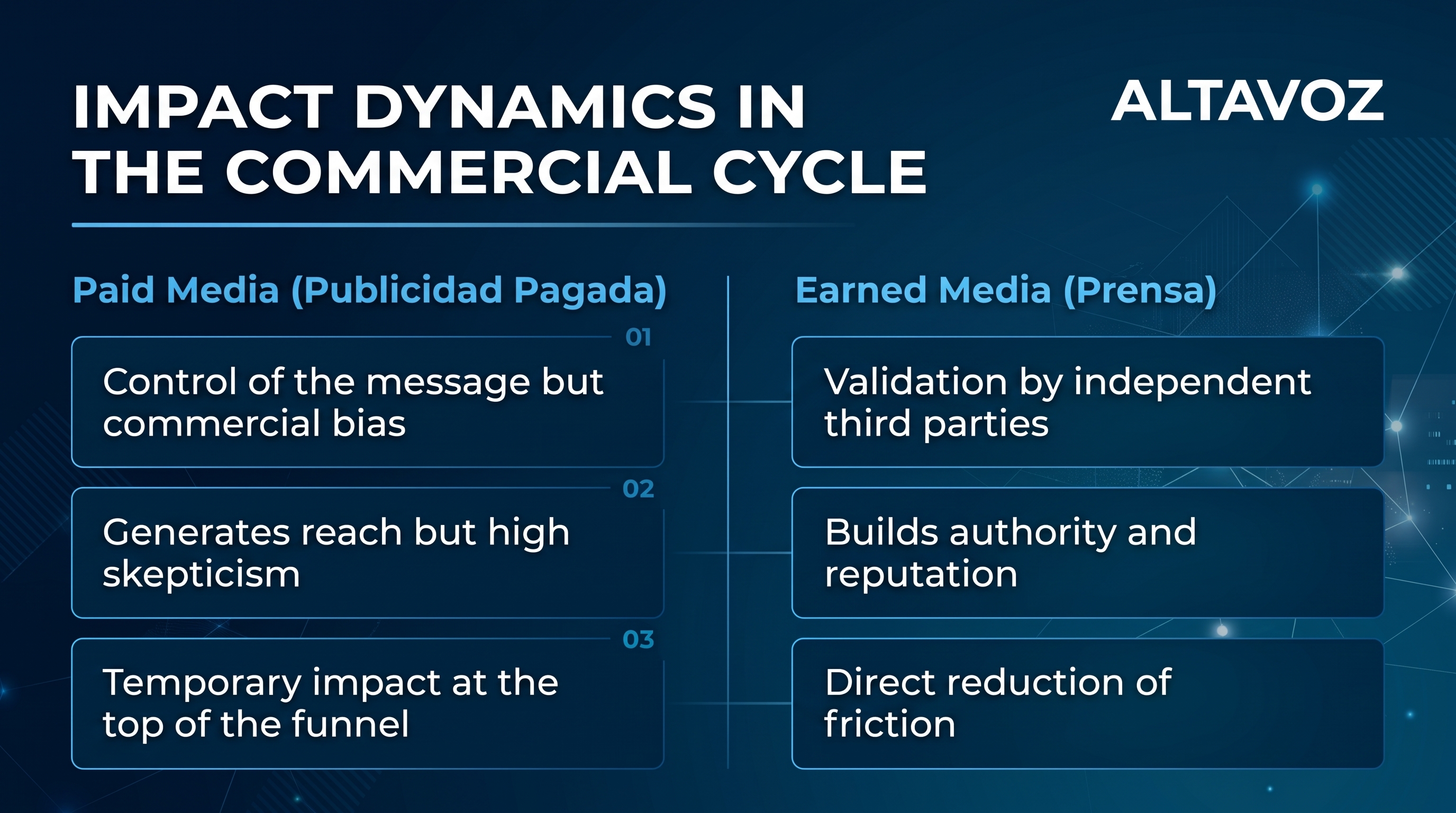
Three ways earned media accelerates B2B sales cycles
Media coverage is not just a brand building activity; it functions as a core sales enablement asset that directly enhances commercial efficiency:
1. Neutralizing perceived risk during technical evaluation phases
In complex B2B deals, the primary bottleneck is rarely price—it is the fear of operational failure or internal backlash if a vendor underdelivers. A track record of in-depth articles, executive interviews, and tier-1 press features eliminates uncertainty, reassuring buyers that the company is a stable, market-validated partner.
2. Building authority across multi-stakeholder buying committees
B2B procurement involves multiple C-suite stakeholders: CFOs, CTOs, legal teams, and operational heads. While sales reps engage primary user leads, high-tier earned media educates and aligns C-suite decision-makers who hold final budget approval.
3. Creating clear differentiation against silent competitors
When competing proposals feature similar technical specs and pricing, buying committees favor the vendor with stronger public authority and market presence. Being cited regularly as an industry expert positions the company as the default, low-risk choice.

Impact comparison: paid advertising versus earned media validation
Evaluating how each channel performs within the B2B sales funnel highlights why third-party validation excels at closing complex enterprise deals:
| Evaluation variable | Paid Advertising (Paid Media) | PR & Third-Party Validation (Earned Media) |
|---|---|---|
| Message perception | Commercial, promotional, and sales-driven | Objective, authoritative, and editorially vetted |
| Trust contribution | Low; triggers buyer skepticism regarding bias | High; delivers independent institutional backing |
| Sales funnel role | Top-of-funnel awareness and lead generation | Risk mitigation, buyer enablement, and deal closing |
| Reputational durability | Temporary; stops when ad budget ends | Long-term; strengthens digital footprint and brand equity |
| C-Suite influence | Minimal; executives disregard ad banners | Strong; leadership routinely consumes tier-1 news |
Public relations as a revenue multiplier
Corporate communications and media relations should be measured by their ability to protect enterprise value and drive commercial outcomes.
Organizations that treat earned media not as an optional marketing expense, but as a strategic validation engine, successfully position their solutions with authority, overcome buyer friction, and consistently shorten complex B2B sales cycles.
At Altavoz Comunicaciones, we specialize in corporate communications counsel, public relations strategy, and B2B positioning for technology providers, complex service firms, and executive leadership teams. We help organizations transform milestones into high-value editorial narratives, building the media authority needed to empower sales teams and drive business growth.