
The accelerated integration of generative language models, conversational agents and automated systems into corporate communication workflows has transformed companies’ operational efficiency. However, for chief executive officers (CEOs), corporate affairs directors and executive committees, this technological adoption introduces an unprecedented reputational vulnerability. Informational hallucinations, inappropriate responses in customer service chatbots , synthetic images with undetected biases or biases in pricing algorithms can go viral within minutes. According to research on intangible governance published by the Institute for Crisis Management, reputational contingencies arising from technological failures are significantly aggravated by executive paralysis and the lack of specific containment protocols for artificial intelligence errors.
In this landscape, preventing crises caused by AI errors requires establishing a solid digital governance structure, where human oversight (Human-in-the-Loop) and agile response protocols protect credibility, public trust and the brand’s intangible value.
The danger of blind delegation to algorithms
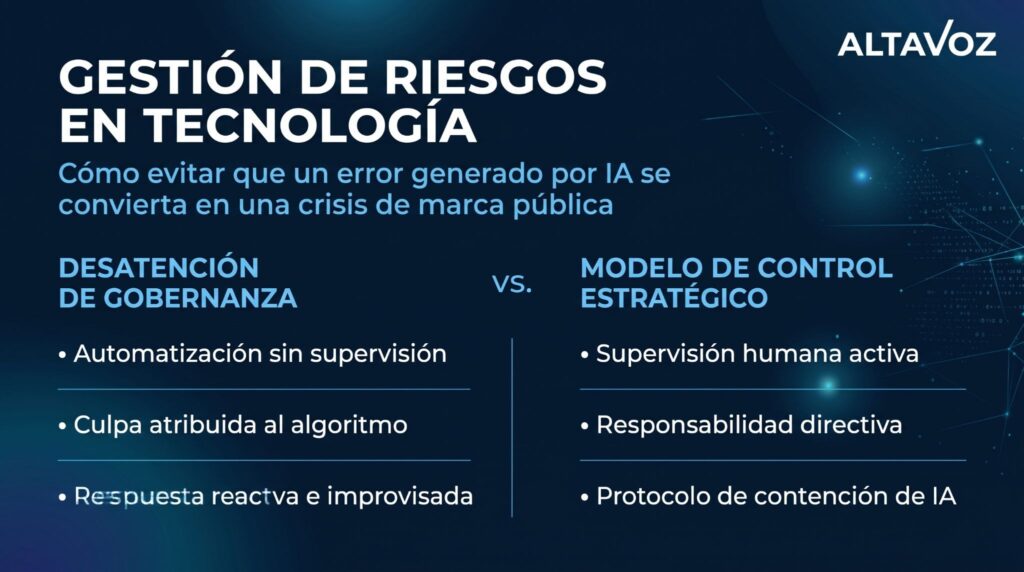
The most serious mistake among decision-makers is to assume that automation exempts senior management from editorial and ethical responsibility for the content published or the company’s algorithmic interactions. Publishing press releases, financial reports, advertising campaigns or user interactions generated by artificial intelligence without a rigorous prior audit creates direct exposure to public failures.
When an algorithmic error comes to light —such as a hallucination about product data or offensive responses on digital channels— the corporate response cannot be limited to blaming the system or the vendor platform. For executive committees, blaming the tool destroys audience trust, reflecting a lack of internal control and corporate governance that erodes institutional reputation.
Four strategic safeguards to neutralize algorithmic risks
To prevent a technical inaccuracy of the technology from escalating into a crisis of media or legal reach, corporate leadership must implement four principles of operational control:
1. Mandatory human review principle (Human-in-the-Loop)
No content generated by artificial intelligence models should reach the public without validation and curation by a trained professional. Establishing strict verification workflows for institutional materials, campaigns and customer service eliminates the risk of publishing false data or inappropriate tones.
2. Rapid disconnection and containment protocol (Kill Switch)
Automated conversational platforms and artificial intelligence agents must have centralized emergency shutdown mechanisms. Upon detecting erroneous responses or anomalous interaction spikes, the team must be able to pause the tool immediately and redirect attention to channels staffed by humans.
3. Transparency and executive accountability
If an algorithmic error reaches the public, the company’s stance must be clear, transparent and swift. Acknowledging the technical failure with empathy, briefly explaining the adjustment implemented and taking institutional responsibility defuses speculation and positions the brand as a mature, responsible organization.
4. Continuous bias and security auditing (Red Teaming)
Subjecting algorithmic systems to periodic stress tests through crisis simulation scenarios (Red Teaming helps identify vulnerabilities, narrative biases or security gaps before the technology interacts with customers, media or investors.
Roadmap for building solid artificial intelligence governance
Aligning technological innovation with the protection of the company’s reputation requires establishing an internal methodology organized in four phases:
- Preparing the AI usage policy manual: clearly define operational limits, authorized platforms and prohibitions on uploading confidential information or sensitive data.
- Training communication and marketing teams: train staff in detecting hallucinations, critically interpreting data and analyzing the context of generative models.
- Updating the corporate crisis management manual: include specific chapters for technological contingencies that cover escalation matrices, specialized spokespeople and official-position templates.
- Continuous reputation monitoring and social listening: implement data intelligence tools that identify screenshots, viral posts or negative mentions associated with the company’s responses in digital environments.
Ethics and oversight as the foundations of the brand
Technology is an amplifier of operational capacity, but market trust rests on human judgment, ethics and executive responsibility.
The organizations that lead their sectors will not be those that systematize processes blindly, but those that know how to integrate the power of artificial intelligence with solid governance that protects the integrity and value of the brand.
At Altavoz Comunicaciones we advise companies and executive committees on designing and implementing comprehensive reputation strategies, corporate communication and risk intelligence. We support organizations in structuring digital governance and crisis prevention protocols, ensuring that technology adoption drives business growth without compromising institutional reputation.