



OpenAI’s new Ads Manager transforms digital demand capture. Learn how to position your enterprise at the exact moment decision-makers evaluate vendors and compare options using artificial intelligence.
Shifting search behaviors among consumers and B2B buyers have accelerated the reallocation of advertising budgets across modern marketing departments. Today, deploying ChatGPT Ads offers a high-value strategic opportunity. It connects brands with over one billion active users who rely on the platform to solve complex problems, compare alternatives, and make informed purchasing decisions. Gartner research shows that over 25% of query volume has migrated from traditional search engines to conversational AI. This shift is compelling brands to rethink their entire digital visibility strategy.
In this evolving landscape, managing campaigns through the OpenAI Ads Manager requires moving beyond conventional programmatic buying based on isolated clicks. For marketing and public relations executives, this channel makes it possible to intercept prospects during active deliberation through native advertising powered by rich contextual signals, while safeguarding institutional credibility.
The danger of applying traditional search logic to conversational AI
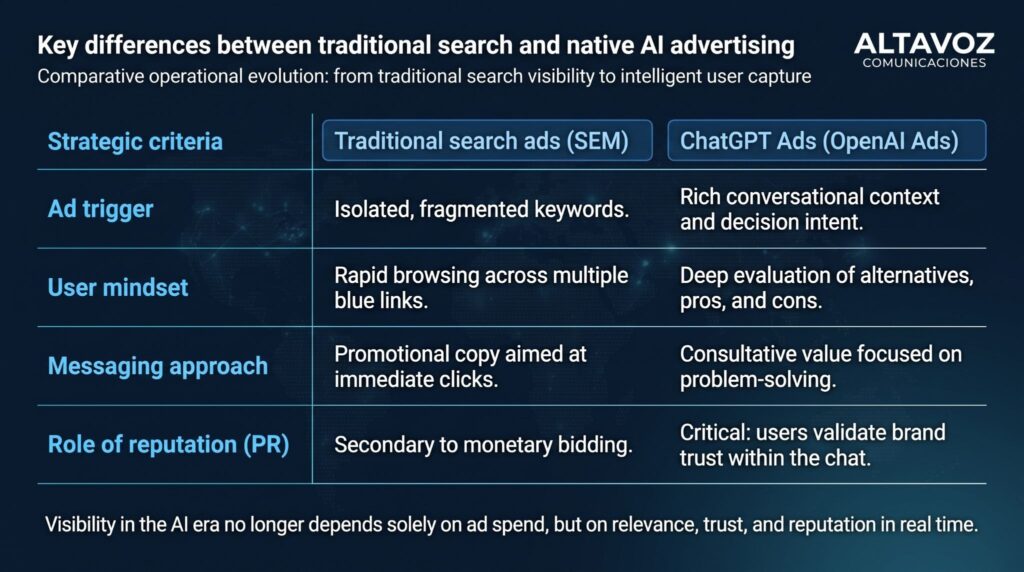
The most costly mistake when entering native AI advertising is replicating disruptive social media tactics or the rigid keyword logic of legacy search engines. Within a conversational interface, users do not type fragmented keywords; they share detailed business challenges, request pros-and-cons comparisons, and evaluate which vendor best aligns with their operational needs.
When an organization deploys generic or overly promotional copy without adding value to the conversational context, it triggers user friction and wastes acquisition budget. An executive board doesn’t just look for platform impressions. It expects ad spend to drive real results: capturing qualified demand, lowering customer acquisition costs (CAC), and strengthening brand authority against direct competitors.
Understanding the architecture of this advertising environment enables communications leaders to pair organic Generative Engine Optimization (GEO) with high-performing paid media.
Four pillars for capitalizing on ChatGPT Ads with executive rigor
To leverage the rollout of the OpenAI Ads Manager without compromising corporate reputation, marketing and communications teams should structure their strategy around four core pillars:
1. Targeting through rich contextual signals and decision intent
Unlike traditional search where brands bid on isolated terms, the platform enables visibility while users explore comprehensive solutions. The goal is not to interrupt, but to present a relevant value proposition at the precise moment a prospect asks the AI to evaluate vendors, compare pricing models, or solve an operational bottleneck.
2. Respecting the trust architecture and editorial separation
OpenAI built its advertising ecosystem around strict governance principles: sponsored placements are clearly labeled and kept entirely separate from organic AI-generated responses. For a communications director, this distinction is critical. Investing in Ads Manager secures timely visibility in discovery modules. However, the core AI response still relies on earned media authority and a strong PR digital footprint.
3. Consultative creative assets focused on problem-solving
Visual assets and copy uploaded to the campaign manager must abandon aggressive sales language. As demonstrated by early enterprise adopters on the platform (such as Best Buy, Lowe’s, and Newegg), the highest-converting formats are those offering comparison guides, ROI calculators, technical demonstrations, or specialized advisory resources directly tied to the user’s query.
4. Synergy between Paid AI media and organic reputation (GEO)
Integrating ChatGPT Ads does not replace organic positioning work; it amplifies it. When a prospect sees a sponsored brand placement, their natural next step within the chat is to ask the AI directly: “How reliable is this vendor?”. If the company lacks third-party press validation, executive thought leadership, and verifiable web authority, conversion will stall at the final stage.
Methodology for deploying campaigns in the OpenAI Ads Manager
Securing measurable return on investment during the platform adoption phase requires executing a disciplined four-step roadmap:
- High-intent prompt mapping: Auditing the complex questions, vendor comparisons, and objections prospects ask AI before purchasing in your category, moving away from legacy short-tail keywords.
- Structured setup in Ads Manager: Defining clear conversion objectives, setting controlled pilot budgets (leveraging initial platform ad credits), and uploading creative assets that directly address mapped business pain points.
- Conversational landing page alignment: Routing ChatGPT Ads traffic toward dedicated landing pages that match the technical depth and consultative tone the user experienced inside the chat, rather than generic homepages.
- Cross-auditing sentiment and pipeline conversion: Tracking not only impressions and click-through rates inside the analytics dashboard, but also marketing-qualified lead (MQL) quality and how paid traffic interacts with organic brand sentiment.
The convergence of intelligent paid media and reputational authority
With the arrival of ChatGPT Ads, a definitive paradigm shift is taking place across the industry: modern buyer attention has concentrated within assisted-answer environments and contextual dialogue.
Category-leading organizations will be those that recognize paid visibility opens the door during active exploration, while solid corporate reputation ultimately closes the deal.
At Altavoz Comunicaciones, we advise business leaders and executive boards on building integrated strategies that bridge public relations, Generative Engine Optimization (GEO), and digital performance. We help organizations capitalize on ChatGPT Ads and emerging artificial intelligence channels under a unified strategic vision, ensuring every advertising dollar is backed by a strong, credible brand reputation built for sustainable growth.