In today’s digital environment, the speed at which an operational or reputational incident spreads often exceeds the response capacity of traditional corporate structures. When a contingency emerges, the first 30 minutes determine whether the event remains a contained incident or escalates into a reputation crisis of media reach. According to corporate risk management data from the Institute for Crisis Management, more than 70% of reputational crises that permanently damage brand value are aggravated by erroneous decisions or institutional silence during the first half hour of the event.
In this landscape, managing reputation crises requires a clear contingency protocol, where executive composure and operational discipline replace reactive improvisation and institutional panic.
The danger of improvisation in reputation crisis management
The most destructive mistake among executive committees facing a public contingency is to respond impulsively or fall into absolute silence. A lack of preparation leads to two extreme scenarios: issuing hasty statements without verifying facts or operational paralysis driven by fear of legal consequences.
Both behaviors erode corporate credibility. While the management committee debates behind closed doors without making decisions, digital audiences and the media fill the information vacuum with speculation. In the era of digital immediacy, if the company does not take the initial narrative, third parties will take control of the public conversation.
A response protocol structured in stages makes it possible to contain the initial spread of the crisis, protecting the organization’s most valuable intangibles: customer trust, institutional credibility and the social license to operate.
Four operational phases to control the contingency in half an hour
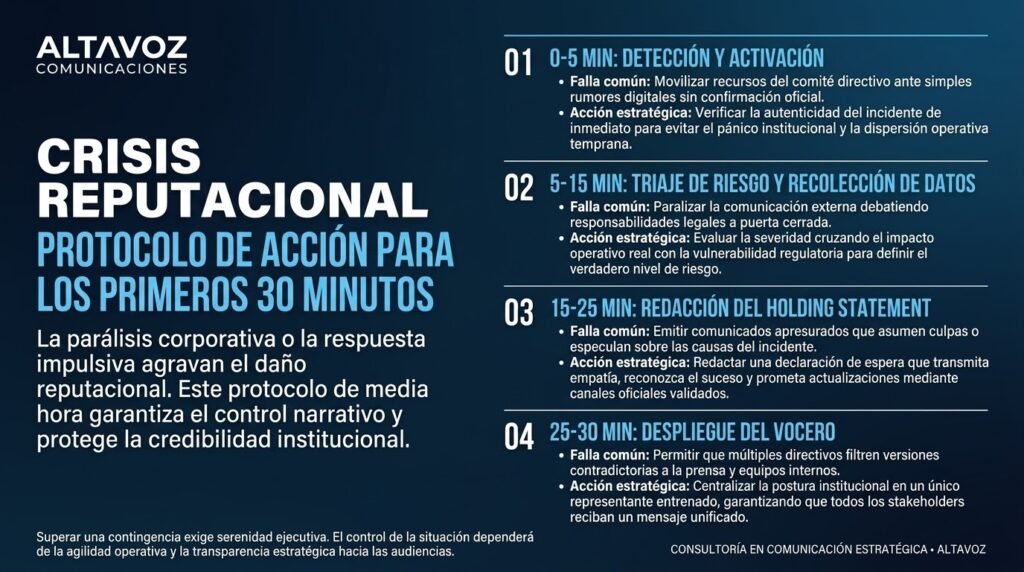
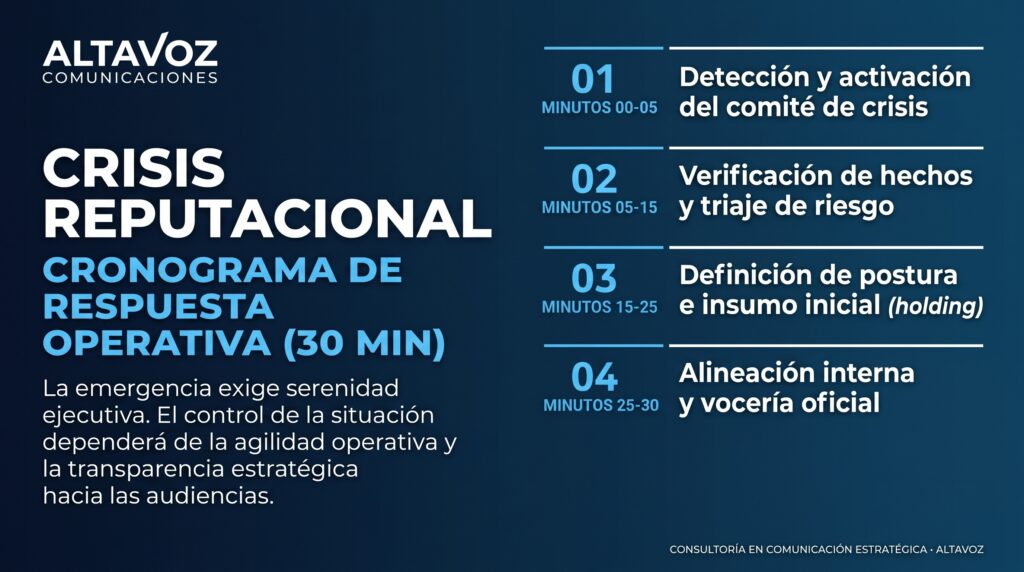
To ensure effective intervention without compromising legal liability or the brand’s reputation, the communication management must coordinate the initial response in four blocks of five to ten minutes:
1. Detection, verification and immediate activation
After the initial alert issued by social listening systems or operations teams, the crisis steering committee is notified immediately. During this first stretch, it is essential to confirm the veracity of the incident and rule out rumors to avoid unnecessary mobilization of corporate resources.
2. Risk triage and fact gathering (fact-checking)
The leadership team assesses the severity level of the event by analyzing three variables: the real operational impact, the potential reach among key audiences and the regulatory or legal vulnerability. In parallel, those responsible for the affected area collect the hard data verified so far: what happened, where, when and what containment measures are underway.
3. Drafting the initial statement or holding statement (holding statement)
With the information available, a brief statement is drafted that acknowledges the situation without speculating on causes or premature blame. This statement must convey empathy, confirm that the company is investigating the event and establish a clear commitment to update the information through official channels.
4. Alignment with key stakeholders and official spokesmanship
Before public release, the position is shared with internal staff, customer service channels and the relevant authorities. A single designated, trained spokesperson takes on institutional representation, ensuring that all of the company’s messages keep a single voice, consistent and transparent.
How to structure a preventive preparedness protocol for reputational crises
The success of an executive response in the first 30 minutes depends on the preventive work done before the emergency arises. A risk mitigation strategy requires implementing a roadmap geared toward institutional preparedness:
- Design and updating of the crisis manual: preparing a dynamic document that defines leadership roles, severity levels, emergency contact matrices and pre-approved communication templates.
- Ongoing training of executive spokespeople: periodic training of corporate leaders in high-pressure spokesperson techniques and crisis drills to assess real response capacity.
- Active digital monitoring and early alerts: implementing social listening and data intelligence tools that detect anomalous spikes of negative conversation before they escalate.
- Preventive vulnerability audit: periodic identification of operational, regulatory and reputational risks to build responses rehearsed in advance.
Composure as a leadership asset in moments of pressure
Properly managing the first half hour of a contingency does not guarantee a definitive resolution of the problem, but it prevents an operational incident from turning into a devastating reputation crisis.
Respected organizations are not those that never face contingencies, but those that respond to adversity with composure, transparency, responsibility and a deep sense of empathy toward their audiences.
At Altavoz Comunicaciones we advise companies and executive committees on designing and implementing comprehensive reputation strategies, reputation crisis management and risk prevention. We support organizations in building agile response protocols, training their spokespeople and protecting the value of their brand against contingencies in the digital and media environment.