The start of a consulting relationship between a communication agency and a company’s executive committee is a defining moment. Often, the initial meetings of a project (onboarding) focus excessively on logistical aspects, delivery formats or media contact lists. Thus leaving aside alignment with the business’s strategic goals. According to studies on strategic consulting from Harvard Business Review, more than 50% of disagreements between external consultants and executives arise from a lack of initial clarity on expectations, business priorities and the definition of success.
At this stage, the person in charge of communication account management must take a senior consulting stance. They must ask direct questions that help understand corporate priorities, anticipate reputational risks and ensure that every public relations action is aligned with the organization’s financial and commercial goals.
The danger of making assumptions without consulting senior management
The most common mistake of account teams when starting a service is to design the work plan based solely on the initial technical report or on superficial requirements. Starting to run campaigns, press releases or spokesperson management without understanding the vision of the chief executive officer (CEO) or the board of directors usually leads to misaligned efforts that provide no real value perceived by the company.
The agency measures its success with isolated metrics, such as the number of publications. In contrast, senior management seeks to resolve crises, protect the brand and enter new markets. This lack of alignment quickly wears down the professional relationship. Prior strategic inquiry avoids this mismatch and positions the agency as an indispensable business ally.
Asking the right questions from day one demonstrates methodological competence. It also makes it possible to identify priorities that do not appear in formal documents. All of this establishes a working framework based on transparency and professional rigor.
The five strategic questions before starting editorial management
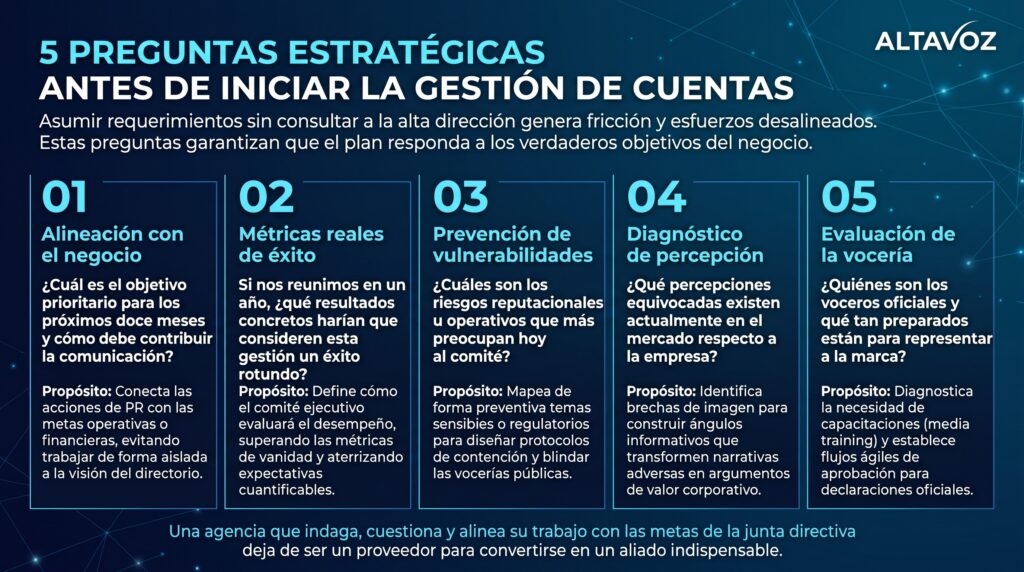
To build a solid, results-oriented roadmap, the consulting team should ask these five essential questions during the immersion phase with senior management:
- 1. What is the business’s priority objective over the next twelve months and how should communication contribute to achieving it?
- Purpose: connect the public relations strategy with the organization’s operational, financial or commercial goals, avoiding working in isolation from the executive vision.
- 2. If we met again in a year, what concrete results would make you consider this engagement a resounding success?
- Purpose: define the real qualitative and quantitative metrics by which executive committees will evaluate the agency’s performance, going beyond vanity metrics.
- 3. What reputational risks or operational vulnerabilities most concern the management committee today?
- Purpose: proactively map sensitive topics, regulatory aspects or past contingencies in order to design a containment protocol and avoid mistakes in public spokesmanship.
- 4. What mistaken perceptions currently exist in the market or among its key audiences regarding the company?
- Purpose: identify institutional image gaps and build informational angles that turn adverse narratives into corporate value arguments.
- 5. Who are the official spokespeople internally and how prepared are they to represent the brand’s position before the media?
- Purpose: diagnose the level of executive preparation, define training needs (media training) and establish internal approval flows for issuing official statements.
Methodology for integrating the answers into the strategic communication plan
Gathering senior management’s vision only has value if that information is translated into a clear, measurable work methodology. The integration process includes four consecutive phases:
- Synthesis of management priorities: consolidate the answers into a brief strategic document that serves as a reference matrix for the whole team assigned to the account.
- Building the message and indicator matrix: design the corporate narrative and define the key performance indicators (KPI) agreed with senior management.
- Validation of the work plan with area leaders: present the strategy to the communication, marketing and public affairs managers to ensure day-to-day operational flow.
- Periodic executive review mechanisms: schedule quarterly evaluation sessions with executives to measure progress, adjust approaches and stay aligned with the evolution of the business.
Rigorous inquiry as the basis of consultative leadership
Knowing how to ask incisive questions of senior management is the hallmark of a communication consultant with business vision.
Agencies that merely receive instructions execute tasks; those that inquire, question constructively and align their work with their clients’ strategic objectives become indispensable partners in decision-making.
At Altavoz Comunicaciones we specialize in providing strategic consulting in corporate communication, public relations and reputation management for companies and executive committees. We support organizations in structuring communication plans based on a rigorous diagnosis, turning business objectives into high-impact narratives that generate trust and sustainable value.