
Communicating your environmental, social, and governance (ESG) impact has become a critical business priority. Yet many organizations fall into two equally damaging traps: exaggerating unverified progress (greenwashing) or staying silent about their initiatives out of fear of public scrutiny (greenhushing). In an environment shaped by skepticism and information overload, talking about sustainability without technical backing and operational consistency erodes corporate reputation rather than protecting it.
This guide lays out the operational criteria to turn your ESG commitments into a clear, measurable, and credible corporate narrative. It is designed for communication directors, sustainability managers, B2B marketing teams, and executive leaders who need to align corporate messaging with actual business strategy and respond credibly to investors, clients, regulators, and employees.
What ESG Communication Is and Why It Directly Impacts Your Business
ESG communication is the strategic process of sharing what an organization does across three interconnected pillars: Environmental, Social, and Governance. Rather than an image campaign or a passing trend, it is a disciplined way to demonstrate accountability and align corporate purpose with the expectations of increasingly informed and demanding audiences.
According to reputation frameworks cited by RepTrak (2022) and Carreras et al. (2013), corporate reputation is a lasting sense of admiration, respect, and trust that drives concrete favorable behaviors toward your company—buying, recommending, investing, or wanting to work there. When ESG practices are communicated truthfully, they reinforce your social license to operate and unlock six measurable business benefits: stronger reputation, deeper stakeholder trust, investor attraction, customer loyalty, retention of values-driven talent, and risk mitigation.
- How to apply it: Connect every sustainability message to a specific business indicator and the tangible value it creates for a defined stakeholder group, rather than publishing generic commitment statements.
- Warning sign: Limiting ESG communication strictly to environmental initiatives while ignoring social impact and corporate governance weakens your narrative and leaves your brand exposed before technical audiences.
Five Core Pillars for Rigorous and Credible ESG Communication
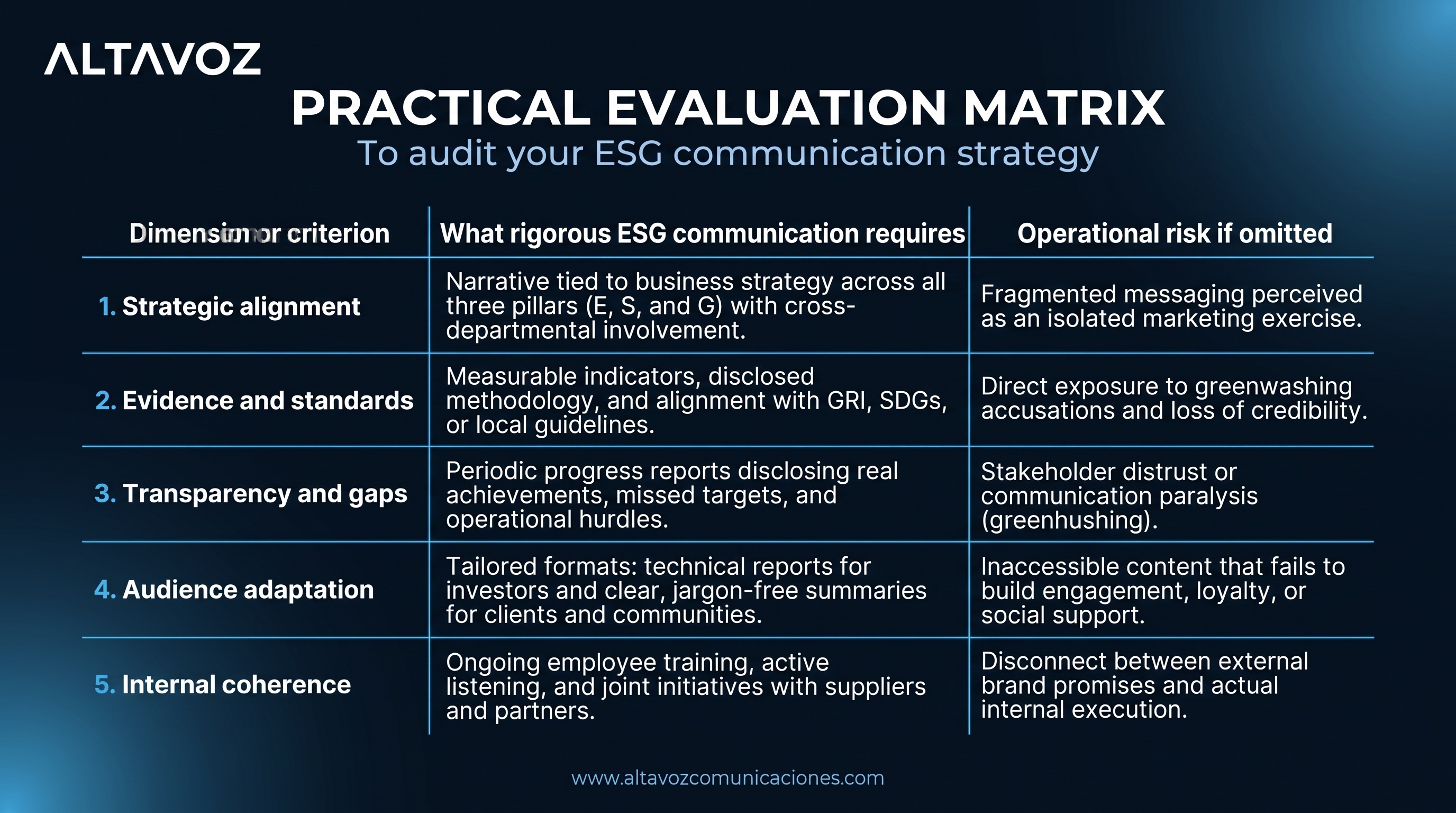
The guide Comunicar la sostenibilidad y su impacto en la reputación (Communicating Sustainability and Its Impact on Reputation), developed by the Corporate Sustainability and Reputation Working Group of WAS (Women Action Sustainability) and Corporate Excellence, identifies five structural pillars that separate effective ESG communication from superficial messaging:
- Strategic and cross-functional: Communication must stem directly from your sustainability strategy, which in turn derives from your core business strategy. Sustainability cannot sit isolated in a single department; every business unit must understand the roadmap and contribute to it.
- Transparent and consistent: Stakeholders expect truthful, traceable information aligned with how the company actually operates. Transparency means reporting verifiable achievements alongside unmet targets and ongoing operational hurdles.
- Built on a 360-degree view (internal and external): Effective communication requires a thorough reading of the social, regulatory, and geopolitical context. Internally, training and engaging employees turns them into credible brand ambassadors; externally, it ensures your sustainability narrative matches the real-world experience of clients, media, and communities.
- Clear and educational: Sustainability is complex, but your communication should not be. Organizations must translate corporate terminology into accessible, inclusive language and use tools like a materiality matrix to focus on what genuinely matters to each audience.
- Collaborative and alliance-driven: A substantial share of any company's impact happens indirectly across its value chain. Communicating partnerships with suppliers, peers, NGOs, public institutions, and media multiplies transformative impact and strengthens corporate credibility.
- What to verify: Audit whether your technical sustainability reports and your commercial messaging share the exact same figures, and check if internal teams understand how their daily roles support ESG goals.
- Mistake to avoid: Publishing aspirational claims without internal alignment or traceable evidence, which exposes your company to greenwashing accusations and immediate stakeholder pushback.
Grounding Each ESG Dimension in Verifiable Proof and Real Narratives
Technical data is essential, but numbers alone rarely inspire action. Effective ESG communication pairs auditable metrics and recognized frameworks—such as the GRI Standards, the UN Sustainable Development Goals (SDGs), or local disclosure guidelines like those from Peru's Ministry of the Environment—with concrete narratives that show real-world results.
In the Environmental pillar, credibility depends on consistency between operations and storytelling. Brands like Patagonia back their environmental positioning with recycled materials, repair and reuse programs, and transparent production disclosures. In the public sector, IHOBE (the Basque Government's Environmental Management Agency) grounds its circular economy and carbon reduction work in measurable data and firsthand accounts, as seen in its Ihobe 40 años Aurrez aurre initiative.
In the Social pillar, communication must demonstrate genuine contributions to community well-being beyond financial returns. Organizations such as Laboral Kutxa, which drives social and cooperative initiatives, and Gureak, dedicated to the workplace inclusion of people with disabilities, earn lasting trust because their social impact is verifiable and central to their purpose.
In the Governance pillar, ethics and regulatory compliance rely on clear codes of conduct, anti-corruption policies, and regular publication of audits and progress reports. Internal communication plays a decisive role here, ensuring that integrity, transparency, and accountability guide daily decision-making across every department.
- What to ask your team: Require every public environmental, social, or governance claim to be backed by a tracked metric (emissions, water usage, employee turnover, compliance rates) and a clear explanation of how it was calculated.
- Warning sign: Promoting isolated green or social campaigns while core business operations move in the opposite direction damages trust far faster than saying nothing at all.
Seven Practical Guidelines to Overcome Distrust and Information Fatigue
Communicating sustainability is structurally difficult: public skepticism toward corporate claims is high, misinformation is widespread, scientific evidence is often presented in dry or confusing ways, and behavioral change rarely delivers immediate personal rewards. Moreover, positive operational progress almost always coexists with unresolved negative impacts.
To cut through skepticism in your editorial content and campaigns, apply seven practical guidelines:
- Be transparent about the journey: Acknowledge openly what your organization is trying to improve and where you genuinely stand in the process.
- Engage without using fear: Empower audiences by showing what positive change is achievable and how they can participate, rather than relying on alarmism.
- Simplify with everyday equivalents: Translate abstract units into relatable daily references (such as expressing resource consumption in liters of water, direct cost savings, or everyday usage time) and strip out unnecessary jargon.
- Anchor every message in facts and data: Sustainability requires scientific rigor and verifiable proof, not opinions.
- Highlight constructive action over catastrophe: As Nicole Seymour notes in Bad Environmentalism: Irony and Irreverence in the Ecological Age—quoting historian Jacob Darwin Hamblin on IPCC communications—relying heavily on catastrophic rhetoric often reinforces skepticism instead of motivating action.
- Differentiate your approach: Generic green-tinted messaging no longer earns attention; develop distinct formats capable of inspiring and mobilizing your audience.
- Stop overusing the word "sustainable": According to the report Words That Work: Effective Language in Sustainability Communication, the top 50 Forbes brands repeat the word "sustainability" an average of 10 times per sustainability webpage, whereas the most sustainable brands use it only once. If you have to repeat the label to persuade your audience, you probably need stronger facts.
- How to apply it: Before approving any press release or report, replace vague labels ("eco-friendly," "green," "sustainable") with the exact metric, recognized standard, or operational change achieved.
- Mistake to avoid: Distributing the same dense technical document to every audience; investors and regulators need auditable reports and dashboards, while customers, suppliers, and communities need clear summaries and visual formats.

Common Mistakes in Corporate ESG Communication
- Falling into greenwashing: Exaggerating environmental achievements or using responsible labels that do not match real operational practices.
- Falling into greenhushing: Remaining completely silent about genuine ESG progress out of fear of criticism, which breeds distance and distrust among stakeholders.
- Reducing ESG to environmental topics alone: Focusing exclusively on carbon or recycling while neglecting social impact, workplace practices, ethics, and governance.
- Disconnecting internal and external communication: Launching public purpose campaigns without first training and engaging the employees who execute the strategy.
- Communicating without metrics or follow-up: Making vague promises without quantifiable targets, clear methodologies, or regular progress reporting.
- Overusing technical jargon or doom-laden rhetoric: Overwhelming non-specialist audiences with regulatory terminology or catastrophic messaging that discourages action.
Frequently Asked Questions About ESG Communication
What is the difference between ESG and ASG?
They refer to the exact same sustainability framework. ESG stands for Environmental, Social, and Governance in English, while ASG (Ambiental, Social y de Gobernanza) is its direct Spanish equivalent.
How can a company avoid greenwashing while still communicating progress?
Back every claim with verifiable data, explain how indicators were calculated, and align disclosures with recognized standards such as GRI or the UN SDGs. Just as importantly, communicate both achieved milestones and remaining operational gaps honestly.
What is greenhushing and why does it hurt corporate reputation?
Greenhushing is the practice of deliberately staying silent about sustainability efforts to avoid scrutiny or criticism. While intended to minimize risk, it often creates distance, fuels skepticism, and causes organizations to miss opportunities with values-driven clients and investors.
Which reporting frameworks should guide ESG disclosures?
Organizations can align their reporting with internationally recognized standards like the GRI Standards and the Sustainable Development Goals (SDGs), alongside local regulatory frameworks such as national environmental ministry disclosure guidelines.
How should ESG messages be adapted for different stakeholders?
Match the format to each group's decision-making needs: provide technical reports and traceable dashboards for investors and regulators, and translate those same findings into concise summaries, infographics, and plain language for customers, suppliers, and local communities.
Turn Your ESG Commitments into Measurable Trust
Rigorous ESG communication is not about speaking louder or repeating buzzwords; it is about proving with verifiable evidence how your organization manages its environmental, social, and ethical footprint. When business strategy, operational data, and corporate storytelling move in lockstep, communication stops being a routine broadcast and becomes a direct driver of reputation and long-term resilience.
Is your organization looking to structure its ESG communication strategy, translate complex sustainability reports into clear narratives, or safeguard its corporate reputation under heightened scrutiny?
At Altavoz Comunicaciones, we combine public relations, editorial communication, digital strategy, and advertising to help companies and institutions build coherent, evidence-based corporate narratives tailored to every stakeholder group.