In corporate communications and public relations, career advancement requires moving beyond tactical execution. While early career stages focus on efficient content production, media list management, and operational logistics, stepping into senior leadership demands a fundamental shift in professional perspective. According to executive development research published by the Public Relations Society of America (PRSA), over 60% of transition challenges in senior PR roles stem from maintaining a task-oriented mindset instead of embracing a business-driven vision.
In this landscape, mastering key competencies for PR strategist success requires connecting brand reputation management directly to executive decision-making, commercial profitability, and reputational risk mitigation.
The risk of remaining trapped in tactical execution
The most common mistake PR professionals make when aiming for executive leadership is measuring success solely by deliverable volume. Reporting on email volume, pitch count, or press release totals reflects an operational mindset that fails to demonstrate direct business value to executive boards.
When communication management is restricted to execution without diagnosing broader business needs, public relations is viewed as a dispensable cost center. Strategic thinkers ask not only what to communicate, but why it is being communicated, through which channels it achieves maximum resonance, and how it directly affects company trust and revenue growth.
Making the leap to strategic consulting requires building analytical and interpersonal capabilities that enable professionals to defend communications value in the boardroom.
We build reputation

Four essential skills for leading communications strategy
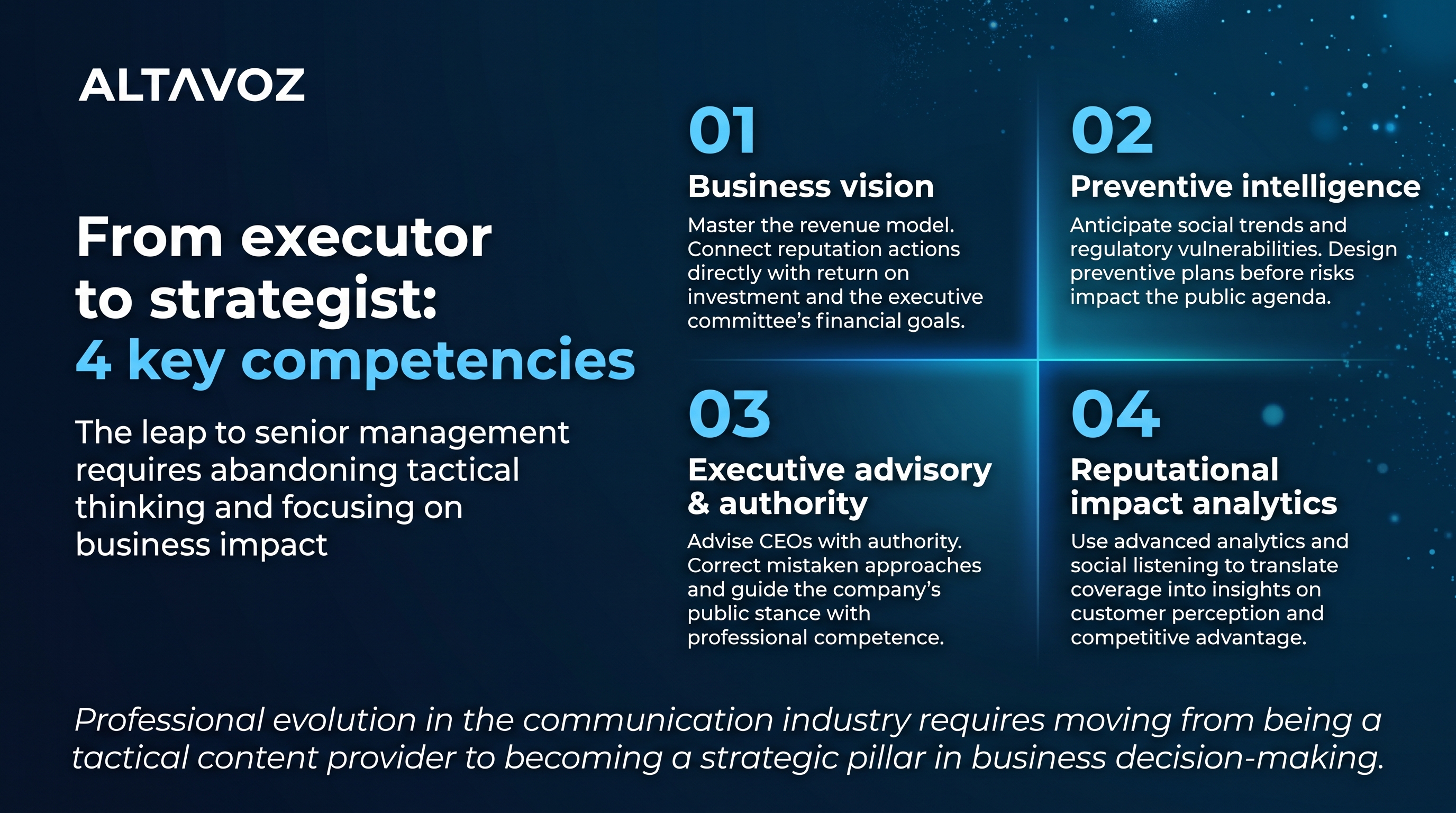
To successfully execute this transition and position oneself as a trusted advisor to senior executives and boards, professionals must cultivate four core competencies:
1. Analytical thinking and business acumen
A senior PR strategist must thoroughly understand an organization's financial structure, revenue model, and commercial challenges. Speaking the language of business enables professionals to align media and reputation initiatives with core enterprise targets, framing PR return on investment clearly and quantitatively.
2. Predictive risk management and environmental intelligence
Beyond reacting to incidents, a senior advisor must anticipate regulatory vulnerabilities, societal shifts, and public sentiment trends before they escalate into breaking news cycles. Conducting scenario analysis and structuring preventive crisis containment plans are among the most valued assets in executive leadership.
3. C-Suite advisory and executive diplomacy
Engaging with CEOs, managing directors, and executive boards requires professional authority, conciseness, and diplomacy. A PR strategist does not simply take orders; they possess the authority to guide leadership positioning, constructively challenge flawed approaches, and lead executive media coaching with a high-level consultative tone.
4. Data integration and impact-driven measurement
Moving past vanity metrics requires mastering digital analytics tools, sentiment analysis, and social listening to assess overall brand health. Translating earned media coverage into actionable insights regarding client perception and competitor positioning solidifies the strategist's leadership role within the organization.
Professional development roadmap for aspirational strategists
Transforming an operational profile into a consultative leadership role requires executing a structured personal development plan:
- Deepening business immersion: studying corporate financial reports, annual business roadmaps, and key operational metrics (KPIs) thoroughly.
- Adopting advanced analytics tools: building expertise in interpreting corporate reputation data to ground strategic recommendations in empirical evidence.
- Developing a consulting mindset: practicing incisive questioning with business leaders before proposing media strategies or campaign concepts.
- Continuous learning in intangible asset management: staying updated on global trends regarding reputation management, crisis protocols, brand governance, and public affairs.
Consultative leadership as the key to professional growth
Transitioning from PR executor to strategist marks the definitive shift toward positioning communications as a core driver of corporate decision-making.
Professionals who successfully integrate business acumen, risk analysis, and impact measurement will not only earn executive trust, but will also lead the industry with authority and credibility.
At Altavoz Comunicaciones, we prioritize strategic talent development as the foundation for delivering exceptional corporate communications and reputation counsel. We partner with business leaders, brands, and executive teams to design and execute comprehensive public relations strategies that strengthen brand equity and drive business growth.