



Key strategies for preparing a successful tender and selecting the ideal partner
Choosing the right public relations (PR) agency can be a decisive factor in strengthening your brand’s presence. As a decision-maker, you know this process requires a strategic and well-planned approach. The key lies in preparing a request for proposal (RFP) that not only attracts top talent but also ensures you select the ideal partner to achieve your goals.
First, it is essential to be clear about what you want to accomplish. Define your objectives using the SMART criteria: specific, measurable, achievable, relevant, and time-bound. For example, you might aim to increase your brand visibility by 30% within six months or generate 20% more media coverage in key sectors. Having this clarity will guide you throughout the entire process.
The next step is to set a realistic budget. A PRWeek study shows that 60% of companies without a defined budget end up spending 25% more than planned. Therefore, make sure you establish an investment range that considers not only the agency’s fees but also campaign-specific costs and potential unforeseen expenses.
Your brief is the agency’s first impression of your company. It should be clear and concise, including information about your organization, market analysis, and expectations for the agency’s work. Consider including elements such as your company’s history, mission and vision, as well as competitor analysis and industry trends.
Once this document is ready, research and select agencies that align with your objectives. Evaluate their previous experience in your industry, the dedicated team they would assign to your brand, their use of AI to automate processes, and their ability to combine creativity with communication tools to amplify your message organically at scale. For example, if your company operates in the tech sector, look for agencies that have worked with startups and can demonstrate success stories backed by tangible results.
With your shortlist of potential agencies, send out your brief and set a deadline for proposals. Make sure these include a communication plan and a timeline with deliverables. When reviewing the proposals, evaluate each one in terms of creativity and strategy. Ask yourself: Is the proposal innovative? Does it align with my objectives? Investigate their client service processes and identify how they differ from other options. Also, consider the potential brand impact and the expertise of the assigned team.
Invite the finalist agencies to present their proposals. This will allow you to meet the team, assess chemistry and communication, and ask specific questions about their approach. This step is critical, as the relationship with the agency will be fundamental to the success of your campaigns.
After the presentations, gather feedback from your team and make an informed decision. Consider alignment with your goals, confidence in their execution capabilities, and the added value each agency can provide. Once you have selected an agency, ensure the contract is clear and detailed. It should specify services, delivery dates, and payment terms. This will prevent misunderstandings and establish a solid foundation for collaboration.
Maintain a consistent communication channel with the agency. This will enable you to adjust strategies as needed, monitor progress toward objectives, and foster a collaborative relationship. To make the process even more effective, consider incorporating innovative practices. Use data analytics tools to measure campaign effectiveness in real time. You can also identify and collaborate with relevant influencers to amplify your message. Additionally, integrating automation technology can optimize relationship management and performance tracking.
Preparing an RFP for hiring a public relations agency in LATAN or Spain doesn’t have to be overwhelming. By following these steps and strategies, you’ll be on your way to finding the ideal partner to propel your brand to success.
Are you ready to launch your PR tender?
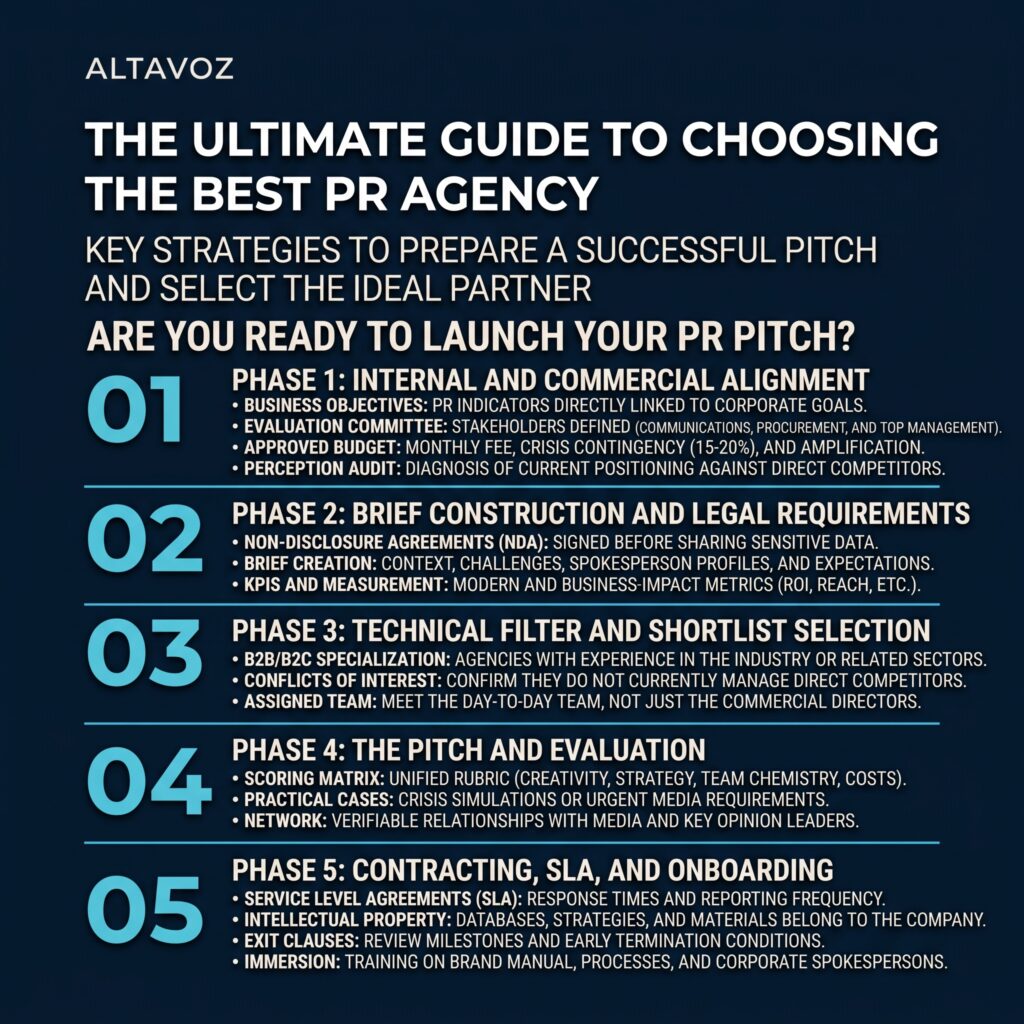
Phase 1: Internal and commercial alignment
- [ ] Definition of Business Objectives: Public relations indicators are directly linked to corporate goals (e.g., entering a new market, mitigating regulatory crises, talent attraction, or ESG positioning).
- [ ] Evaluation Committee Established: Internal stakeholders involved in the decision-making process have been defined (Communications Department, Procurement, and Executive Management).
- [ ] Comprehensive Budget Approved: The allocated amount covers the monthly retainer, a crisis management contingency fund (an additional 15–20%), and a budget for campaign amplification or special events.
- [ ] Current Perception Audit: A clear diagnostic of the brand’s current positioning relative to direct competitors is in place to provide the agency with a realistic baseline.
Phase 2: Corporate briefing and legal requirements
- [ ] Non-Disclosure Agreements (NDAs) Signed: All invited agencies must sign an NDA prior to receiving sensitive company information or market data.
- [ ] Corporate Brief Development: The document details industry context, mission, regulatory challenges, official spokesperson profiles (C-level), and coverage expectations.
- [ ] Definition of KPIs and Measurement Methodologies: Modern, business-impact metrics are established (e.g., ROI, advertising value equivalency, reach, etc.).
Phase 3: Technical screening and shortlist selection
- [ ] B2B/B2C Specialization Mapping: Shortlisted agencies have experience in the company’s specific industry and have managed accounts of a similar scale (or a closely comparable sector).
- [ ] Conflict of Interest Check: Confirmed that evaluated agencies do not currently handle the account of any direct competitor.
- [ ] Assigned Team Evaluation: Request for the exact structure of the team handling day-to-day operations (director, strategists, account managers), not just the senior leadership delivering the pitch.
Phase 4: Pitch presentation and comprehensive evaluation
- [ ] Unified Evaluation Scorecard: The internal committee uses a standardized rubric to evaluate all agencies (creativity, strategic viability, team chemistry, technical innovation, and cost structure).
- [ ] Case Studies or Crisis Simulation: Assessment of how the agency team reacts to a hypothetical reputational crisis scenario or an urgent media request.
- [ ] Contact Network Evaluation: The agency demonstrates solid, verifiable relationships with key opinion leaders, journalists, and key industry associations.
Phase 5: Contracting, SLAs, and onboarding
- [ ] Defined Service Level Agreements (SLAs): The contract stipulates maximum response times and reporting delivery frequency.
- [ ] Clear Intellectual Property Rights: Legal clauses establish that all media lists/databases, strategic plans, and graphic assets generated during the contract remain company property.
- [ ] Exit Clauses and Periodic Evaluation: Review milestones (e.g., at 45 days) and clear early termination conditions are established in case of KPI non-compliance.
- [ ] Institutional Onboarding Schedule: A structured plan is in place for the agency team to receive training on brand guidelines and internal protocols, as well as introduce key company spokespeople.