When planning an annual communications and marketing budget, many executives face the same dilemma: invest in a public relations agency to earn press credibility, or hire a media agency to secure mass reach through paid placements. Making the wrong choice not only slows growth—it often leads to disconnected campaigns where ads make promises that the brand’s reputation cannot yet back up.
This guide is built for marketing directors, general managers, and B2B or consumer-brand commercial leaders who need to allocate budgets with business criteria. Below, we break down what each service solves, how SEO and SEM complement each other in the digital arena, and why partnering with an agency that masters both fronts multiplies the return on every dollar invested.
What a public relations agency brings to your brand
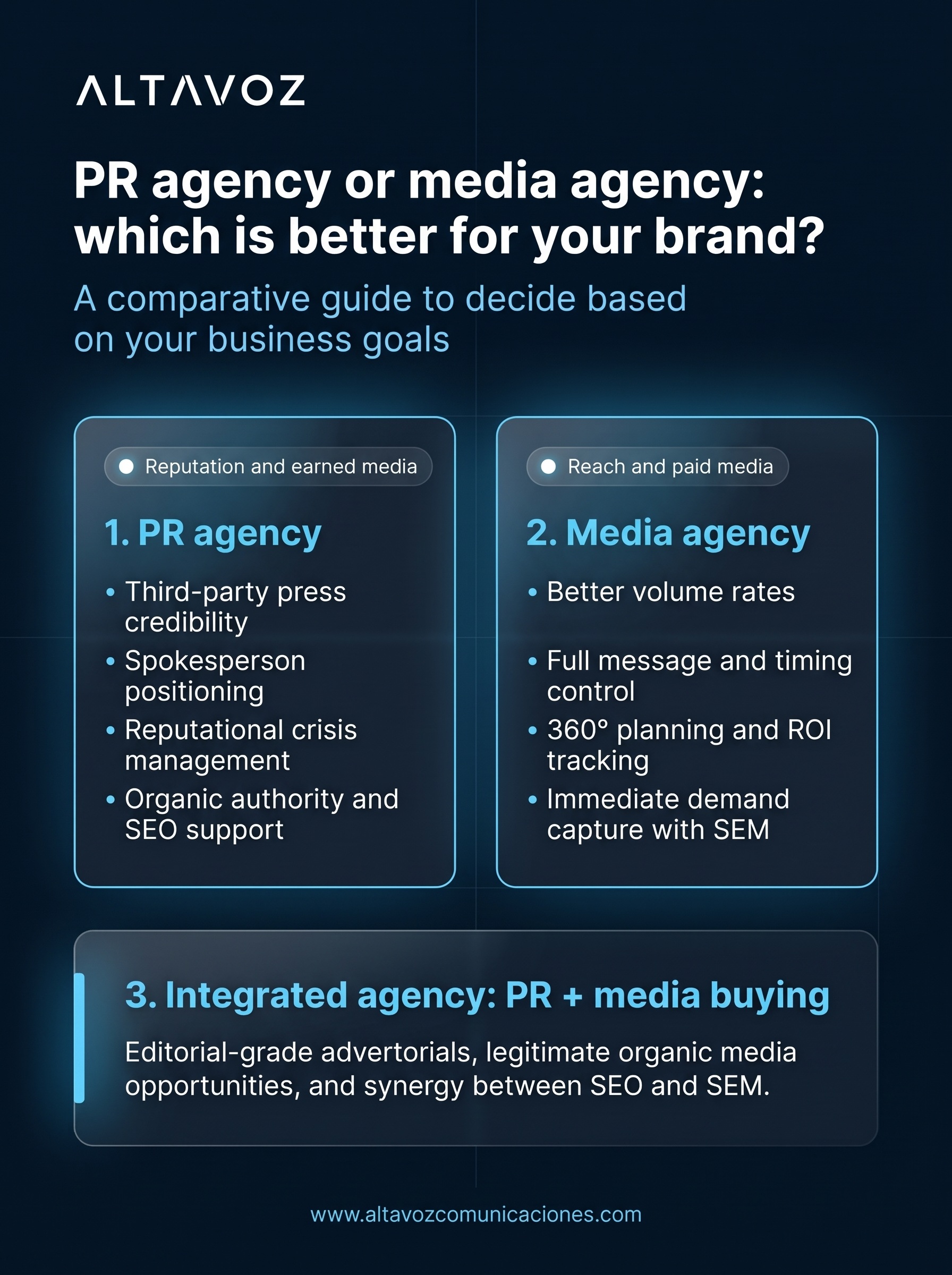
A public relations (PR) agency focuses on building, positioning, and protecting your company’s reputation through professional relationships with news outlets. Its job is not to buy ad space, but to turn your organization’s milestones, data, and spokespeople into relevant stories for journalists, editors, and specialized audiences.
When a newspaper, news portal, radio station, or television channel publishes an interview or feature about your company, audiences perceive it as an objective, third-party validation. Nielsen’s Global Survey of Trust in Advertising—conducted among more than 29,000 internet respondents across 58 countries—confirmed that earned media formats consistently achieve higher trust levels than traditional paid advertising, precisely because the endorsement comes from an independent source.
The most concrete operational benefits of hiring a PR agency include:
- Access to established editorial networks: connects your value proposition with key journalists and trade media in your sector, accelerating visibility among clients, partners, and investors.
- Spokesperson positioning (thought leadership): prepares your executives through media training to participate in interviews, panels, and opinion columns, turning them into industry references.
- Media crisis management: establishes rapid-response protocols, key messages, and coverage monitoring to contain reputational damage before it escalates.
- Narrative consistency and commercial backing: mentions in authoritative outlets serve as social proof that your sales team can leverage in RFPs, proposals, and corporate presentations.
- Sustainable digital authority (digital PR): coverage on high-authority news portals generates brand mentions and referral links (backlinks) that strengthen your domain credibility over the long term.
What to verify: ask for a verifiable portfolio of coverage secured in relevant industry outlets, clarity on their journalistic pitching methodology, and reports with real metrics (media tier, key messages published, sentiment, and editorial reach).
Red flag: be wary of vendors who guarantee front-page coverage or a fixed number of organic placements before evaluating your company’s newsworthiness; editorial judgment always belongs to the media outlet.
What a media agency solves and why it optimizes your ad spend
While PR builds credibility without paying directly for space, a media agency specializes in planning, negotiating, buying, and optimizing advertising inventory across paid channels (paid media). Its core goal is to ensure your message reaches the exact target audience, at the right frequency, and at the lowest possible cost.
Unlike direct buying—where a single brand negotiates standard rate cards on its own—a media agency consolidates spend across multiple advertisers. That buying volume gives it negotiating leverage to unlock discounts, added-value placements, and preferred inventory across television, radio, print, out-of-home (OOH), and digital environments.
The main benefits of working with a media agency include:
- Better rates and budget efficiency: economies of scale lower the cost per impression compared to direct contracting, making the same budget stretch across more channels or longer flighting periods.
- 360° strategic planning: analyzes audience behavior and competitor tactics to design the most profitable media mix across traditional and digital platforms.
- Access to exclusive inventory: certain high-demand formats, special packages, and prime placements are only commercialized under preferential terms through media agencies.
- Full control over message and timing: unlike earned coverage, paid media launches on the exact date your business requires—such as a product launch, seasonal campaign, or commercial promotion—with word-for-word message approval.
- Real-time measurement and optimization: across digital formats (CPM, CPC, or CPA) and programmatic buying, the team continuously adjusts budgets, targeting, and creatives to improve return on investment (ROI).
What to ask for: demand full transparency on media rates, agency commissions, channel-by-channel breakdowns, proof of airing or placement screenshots, and a metrics dashboard tied to business outcomes—not just raw impressions.
Mistake to avoid: hiring a media agency solely for the steepest discount without verifying real audience affinity; cheap ad space placed in front of the wrong audience is still wasted budget.

The digital landscape: why your brand needs to combine SEO and SEM
When the decision moves to the digital ecosystem, the same dynamic between earned and paid visibility plays out in search engines through two complementary disciplines: SEM (Search Engine Marketing) and SEO (Search Engine Optimization). Understanding how each works prevents you from relying exclusively on monthly ad spend or waiting months without capturing immediate demand.
SEM—primarily pay-per-click campaigns on Google Ads—plays a role in digital equivalent to that of a media agency. Its operational advantages are immediate:
- Instant visibility: puts your brand at the top of search results from day one, making it ideal for launches, high-intent commercial services, or urgent lead generation.
- Precise targeting: controls geographic location, schedules, devices, and exact search terms to concentrate spend on users ready to request a quote.
- Message and conversion lab: delivers fast data on which value propositions, keywords, and landing pages convert best—valuable intelligence to guide the rest of your strategy.
SEO, by contrast, builds owned digital assets and organic authority, working hand in hand with the reputation driven by PR. According to BrightEdge research on search traffic, organic search accounts for roughly 53% of trackable website traffic, compared to 27% from paid search. Its structural benefits include:
- Compounding, sustainable traffic: unlike SEM—where traffic stops the moment you pause spend—a well-ranked article or service page continues attracting qualified visits month after month without a cost per click.
- Higher user trust: users tend to place greater credibility in organic results than in sponsored links, resulting in stronger click-through rates on informational and comparative searches.
- Visibility in AI answer engines (GEO): today’s B2B buyers also consult AI assistants before contacting vendors. As BrightEdge documents in its analysis of SEO versus SEM, appearing in AI-generated answers depends on organic authority, structured content, and third-party mentions—not paid ads.
When you integrate both fronts, SEM captures demand today and validates which keywords drive revenue, while SEO—reinforced by backlinks and press mentions secured by your PR team—lowers acquisition costs over the medium term and positions your brand as a sector authority.
How to apply it: cross-check your highest-converting Google Ads search term reports every month against your SEO editorial calendar and press angles so you can target your most profitable queries with organic content.
Red flag: allocating 100% of your digital budget to paid ads without building organic rankings or optimized landing pages drives up your cost per lead year after year as auction competition intensifies.
Integrated agency (PR + media buying): how to master media from both angles
In practice, hiring a PR agency on one side and a media agency on the other often creates operational friction: two separate briefs, two disconnected calendars, and inconsistent messaging between what a spokesperson says in an interview and what an ad promises.
An agency that integrates public relations, media buying, and digital marketing masters the media ecosystem from every angle. This dual capability creates tactical advantages that no isolated vendor can replicate with the same efficiency:
- Editorial precision in advertorials and branded content: many brands invest in sponsored articles that underperform because they read like sales brochures and lose readers in seconds. When the same team masters both the journalistic craft of PR and the commercial negotiation of a media agency, advertorials are written with news structure, useful data, and a genuine angle that holds attention and positions your brand message without triggering reader resistance.
- Access to complementary organic opportunities: maintaining a consistent, professional commercial relationship with media outlets opens smoother lines of communication. Without compromising editorial independence or confusing paid space with news, an agency operating on both fronts understands each outlet’s editorial calendar, special supplements, and thematic needs—making it easier to spot legitimate opportunities for interviews, spokesperson commentary, or organic mentions when a solid news angle exists.
- Smart amplification under the PESO model: earned coverage in a prestigious outlet carries strong credibility, but its organic shelf life can be short. By integrating PR and paid media, that same interview or opinion column can be amplified with targeted spend on LinkedIn Ads, Meta Ads, or digital publishers toward specific decision-makers, multiplying the impact of editorial validation.
- Budget efficiency and brand consistency: a single team aligns launch calendars, spokesperson visibility, advertorials, SEO, and SEM under one set of commercial KPIs, eliminating duplicated effort and internal coordination costs.
What to ask for: request an integrated plan where corporate narrative, press calendar, paid media (traditional and digital), and SEO/SEM strategy share common objectives and a single monthly performance report.
Mistake to avoid: using ad spend as direct leverage to demand editorial articles with no news value; that practice damages relationships with journalists and erodes your brand’s credibility in the newsroom.
What communication strategy does your brand need?

| Brand goal or business need | Recommended approach | Key operational benefit |
|---|---|---|
| Build reputation, position spokespeople, or manage press crises | Public relations (PR) agency | Third-party credibility and professional media relations |
| Maximize mass reach on exact dates or scale sales with ads | Media agency / Paid Media | Volume rate negotiation, full message control, and ROI optimization |
| Capture immediate digital demand and build lasting Google & AI authority | Integrated digital marketing (SEM + SEO) | Balance between short-term leads and lower acquisition costs |
| High-impact launches, effective advertorials, and 360° coverage | Integrated agency (PR + media buying + digital) | Cohesive editorial messaging, broader media leverage, and PESO synergy |
Common mistakes when choosing between PR and a media agency
- Deciding on monthly fees alone: comparing retainers without evaluating sector experience, media contacts, or real buying leverage usually ends up costing more due to weak results.
- Expecting direct sales from PR in month one: public relations builds trust and accelerates commercial closing, but it does not replace a performance campaign designed for immediate conversion.
- Investing in paid media without reputational backing: driving mass traffic to a brand with no press presence, reviews, or organic authority on Google increases acquisition costs because prospects hesitate before buying.
- Publishing advertorials with a hard-sell tone: wasting paid editorial space on self-promotional copy drastically cuts reading time and audience impact.
- Running PR, paid media, and SEO in disconnected silos: when agencies do not share insights, the company pays twice to research audiences and misses the chance to amplify its strongest milestones.
Frequently asked questions
Can I hire a PR agency and a media agency at the same time?
Yes, it is viable for large companies with internal teams able to coordinate both vendors. However, for most mid-sized and corporate organizations, working with an integrated agency is more efficient because it unifies strategy, narrative, media buying, and reporting under one roof.
Does an advertorial replace an organic press release?
No—they serve different, complementary purposes. An advertorial guarantees full control over messaging, links, and publication dates through paid placement, while a PR-managed press release seeks independent editorial validation. Combining both with journalistic criteria maximizes credibility and reach.
How long does it take to see ROI from SEO compared to SEM?
SEM generates impressions and clicks within hours of launching a campaign, as long as budget remains active. SEO typically requires 3 to 6 months to build rankings on competitive terms, but it delivers ongoing traffic without paying per click and strengthens visibility in AI-powered search.
Does buying ad space in an outlet guarantee organic coverage?
There is no automatic guarantee, because commercial teams and newsrooms operate independently. However, an agency that maintains both commercial and editorial relationships with media outlets understands their agendas and formats, making it easier to pitch genuinely newsworthy topics and capture legitimate organic opportunities.
What budget do I need to combine PR, media buying, and digital?
The right budget depends on your industry, market, and growth targets. Rather than splitting spend evenly by intuition, prioritize based on your business stage: lean heavier on SEM and paid media if you need fast commercial traction, or focus more on PR, SEO, and content if your primary challenge is differentiation and trust.
Build a strategy that masters every angle
Choosing between a public relations agency and a media agency does not have to be an either-or decision. Brands that grow sustainably combine the credibility of earned media with the precision and scale of paid placements—both in traditional channels and across the digital ecosystem through SEO and SEM.
Are you evaluating how to structure your communications and media investment to achieve stronger visibility and commercial return?
At Altavoz Comunicaciones, we integrate media-focused public relations, media planning and buying, digital marketing (SEO and Paid Media), advertising, and editorial services under a single B2B and corporate strategy. Our team crafts the journalistic angle of your advertorials, manages real editorial opportunities, and optimizes your paid and organic presence so every action drives measurable results.