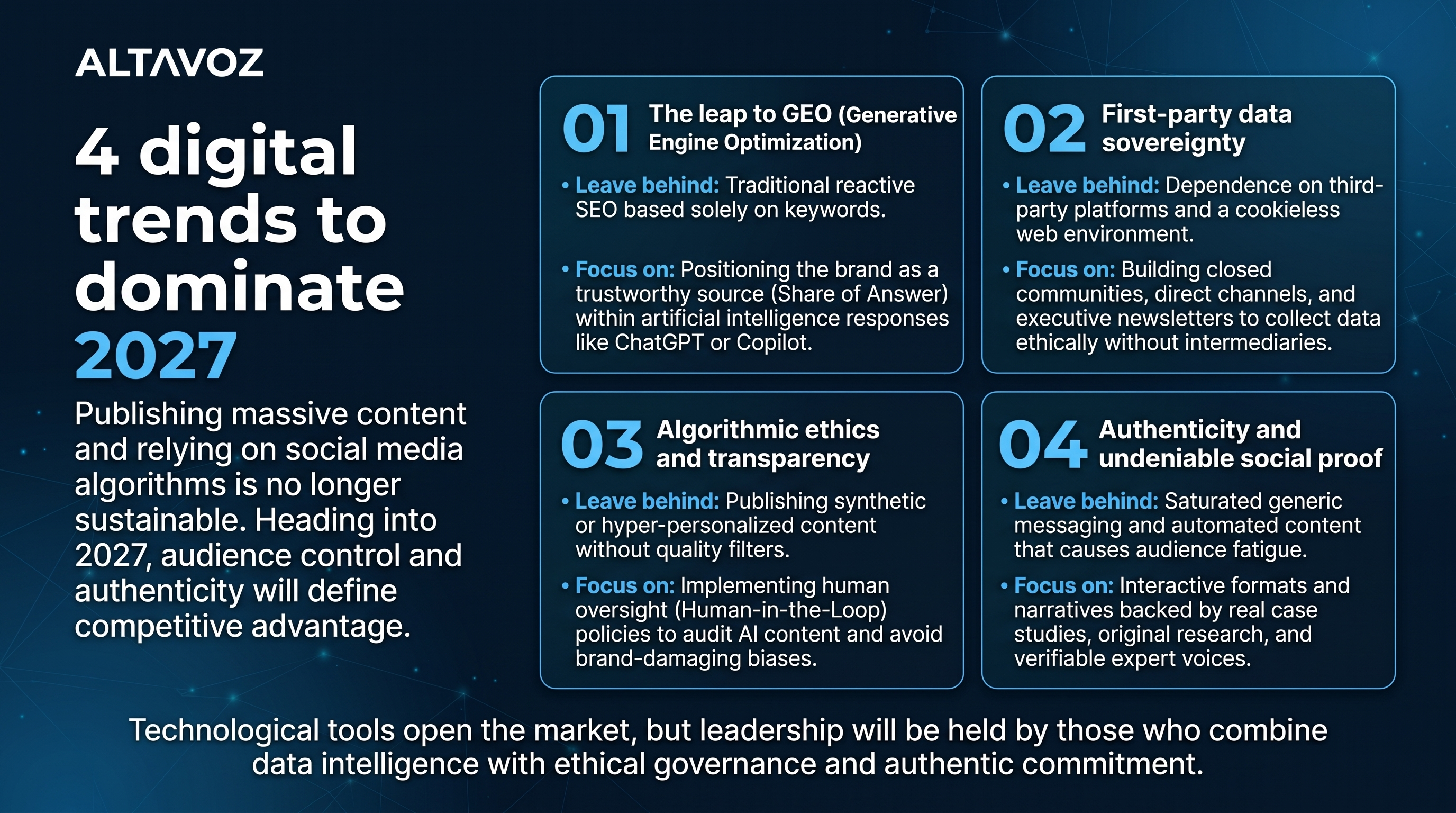
The accelerated transformation of digital environments and the consolidation of generative artificial intelligence have redefined corporate communications. For executive boards, marketing directors, and corporate affairs managers, anticipating technological shifts is not a speculative exercise, but a strategic planning necessity. Heading into 2027, corporate success will no longer depend on mass presence across fragmented channels, but on data sovereignty, strategic visibility within conversational search platforms, and public trust building.
In this environment, digital communication trends in 2027 require moving beyond task automation toward a reputational governance framework, where message authenticity and analytical precision serve as core competitive advantages.
The danger of synthetic noise and loss of digital audience ownership
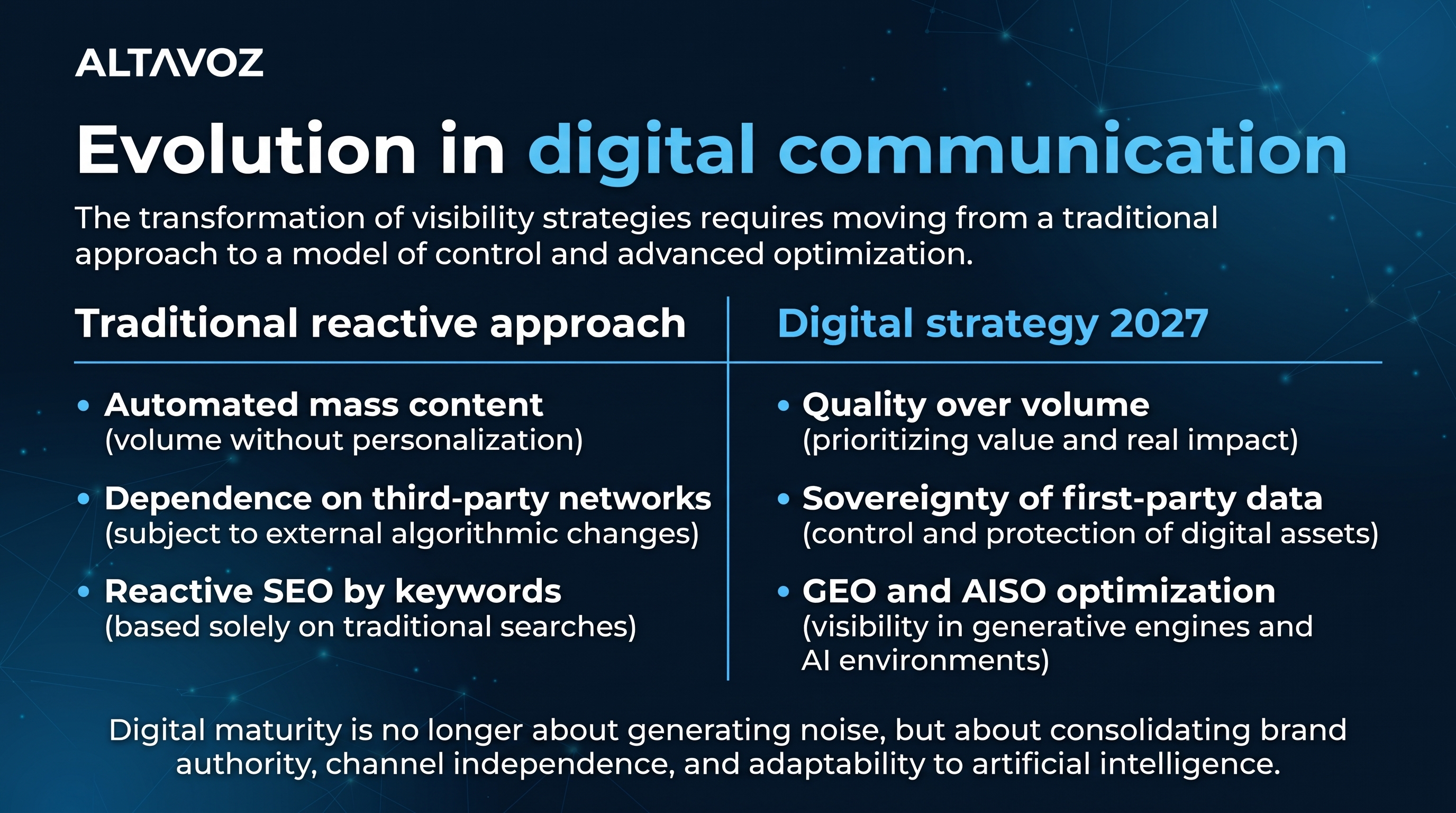
The most critical mistake communications departments make during digital transformation is prioritizing content output volume over strategic quality and audience ownership. The mass proliferation of algorithmically generated content has created audience fatigue, leading consumers and newsrooms to instantly spot a lack of corporate substance.
Simultaneously, over-relying on third-party social media algorithms with volatile organic reach exposes institutional messaging to constant risk. Organizations that fail to build owned distribution channels and adapt narratives to AI-driven search architectures will lose visibility among key stakeholders.
Four strategic trends to lead the digital landscape
To maintain institutional relevance and ensure measurable business impact, executive leadership must incorporate these four core dimensions into their corporate roadmap:
1. Consolidation of Generative Engine Optimization (GEO) and multimodal search
Search engine optimization is shifting from traditional keyword ranking (SEO) toward visibility within conversational AI models like ChatGPT, Gemini, Perplexity, or Copilot. By 2027, brands must aim to be cited as authoritative sources in AI-generated answers, tracking Share of Answer (SoA) and optimizing for multimodal search query streams (text, voice, and visual inputs).
2. Audience sovereignty and first-party data ownership
With the complete normalization of a cookieless web, relying on third-party platform data is no longer effective. Leading organizations will focus efforts on building owned distribution direct channels and exclusive communities (executive newsletters, dedicated content hubs, and closed forums), securing ethical and direct user data capture.
3. Algorithmic ethics, AI traceability, and bias mitigation
Hyper-personalization powered by artificial intelligence is viable only when backed by strict transparency standards. Driven by market demands and international regulations, companies must enforce Human-in-the-Loop governance protocols to audit synthetic outputs, protect data privacy, and prevent algorithmic bias from damaging brand equity.
4. Transitioning from superficial content toward authenticity and social proof
Faced with generic marketing noise, discerning audiences demand evidence-backed narratives. Corporate communications will shift toward interactive formats, short-form video for professional networks, and stories grounded in real-world case studies, proprietary research, and accredited expert perspectives.

Methodology to prepare your organization for 2027
Aligning with future digital communication trends requires establishing a continuous internal management roadmap:
- Generative Engine Optimization (GEO) presence audit: assessing how the organization is cited within generative AI search models and identifying content gaps.
- Data architecture and owned channel review: strengthening direct user data capture mechanisms (first-party data) and expanding owned communication touchpoints.
- Establishing an AI and communications governance framework: defining guidelines for ethical generative AI usage, transparency standards, and review workflows for public messaging.
- Continuous enablement in analytical capabilities: training communications teams in data interpretation, strategic messaging, and market environmental scanning.
Technology in service of corporate strategy
Emerging digital trends offer immense opportunities for brand connection, but technology alone cannot replace human judgment or business acumen.
The organizations that will dominate the 2027 communications landscape are not those that hastily adopt every new tool, but those that integrate data intelligence with authenticity, ethical governance, and a clear commitment to stakeholder value.
At Altavoz Comunicaciones, we advise business leaders and executive boards on designing comprehensive reputation management, corporate communications, and digital intelligence strategies. We help organizations stay ahead of digital market shifts, protecting brand equity and driving sustainable business growth.