
In today's corporate and financial environment, the initial evaluation of a company no longer happens exclusively within physical boardrooms or data rooms. Before engaging in formal introductory meetings, investment committees, private equity funds, and corporate decision-makers use generative language models (LLMs) like ChatGPT, Gemini, Perplexity, or Copilot to run preliminary diagnostics on a brand's financial health, executive leadership, and reputational stability.
In this new environment, corporate algorithmic reputation in PR serves as an organization's invisible digital handshake. What AI models synthesize regarding a company's governance, operational risks, or industry milestones depends entirely on the authority, quality, and consistency of the digital footprint built across the public media landscape.
The danger of digital invisibility and synthetic narrative drift
The most critical mistake executive boards make is assuming public perception among investors is fully controlled simply because a corporate website and annual reports are up to date. Conversational AI search engines do not rely solely on owned media channels; they scrape, cross-reference, and evaluate data from business journals, financial news outlets, and independent media coverage (earned media).
If an organization maintains an absent or inconsistent media footprint, AI models encounter an information void. This void creates two immediate reputational risks:
- Distorted view of core value propositions: algorithms default to featuring competitors with stronger press presence, framing the silent company as a secondary player lacking market innovation.
- Amplification of past issues or AI hallucinations: lacking recent, verified third-party data, models may weigh outdated disputes heavily or generate inaccurate claims regarding corporate solvency.
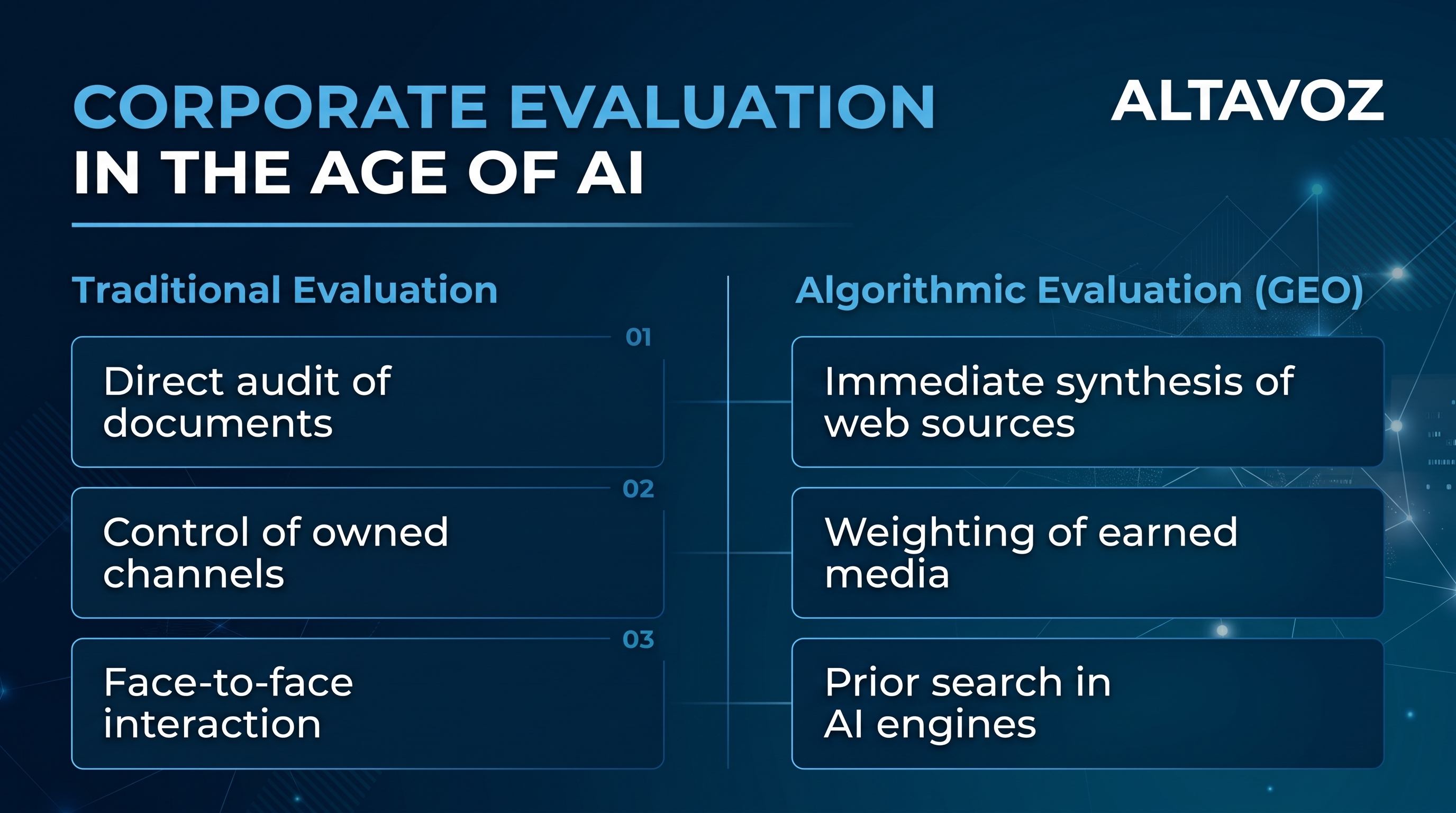
Three factors that shape AI outputs during investment analysis
When an investor queries a conversational AI platform regarding a company's trajectory and stability, the system evaluates inputs across three core dimensions:
1. Authority and prestige of referenced sources
Algorithms are engineered to assign higher credibility weights to economic journals, national newspapers, and tier-1 trade publications. A positive feature in a reputable business outlet exerts a far greater impact on synthesized AI answers than multiple posts on owned corporate blogs.
2. Narrative consistency and messaging clarity
When executive statements, press releases, and sustainability reports maintain a clear narrative regarding the business model, AI engines learn to associate the brand with key corporate attributes such as leadership, innovation, operational efficiency, or financial stability.
3. Frequency and freshness of the digital record
Conversational models prioritize recent information when answering queries regarding an industry's current landscape. Sustaining an active media relations strategy ensures a company's latest achievements are continuously ingested into search engine training sets.
Methodology to audit and safeguard corporate algorithmic reputation
Aligning corporate narratives with generative search engines (Generative Engine Optimization or GEO) requires executive leadership to implement an ongoing, four-stage digital governance workflow:
- Investment query benchmarking (Share of Answer): regularly auditing conversational AI platforms regarding your company's market position, strengths, and risks compared to key competitors.
- Identifying narrative gaps and algorithmic biases: spotting inaccuracies, outdated statistics, or missing corporate milestones within AI-generated answers.
- Authority-driven public relations strategy: deploying targeted media outreach programs focused on securing executive interviews, hard data features, and analysis in tier-1 business outlets.
- Continuous digital asset management: ensuring earned media coverage, corporate newsrooms, and investor relations portals accurately reflect environmental, social, and governance (ESG) milestones.

Media authority as the foundation of financial trust
Algorithmic reputation is not an isolated digital construct; it is the synthesized reflection of an organization's real-world credibility and media presence.
Market leaders in the AI era will be those who recognize that transparency, journalistic validation, and media authority are essential to earning investor confidence and protecting long-term enterprise value.
At Altavoz Comunicaciones, we specialize in corporate communications counsel, public relations strategy, and executive positioning for leadership teams and investor audiences. We help organizations audit and elevate their tier-1 media presence, ensuring public and algorithmic reputations reflect true business strength.