In the realm of corporate public relations, the economics, finance, and business sections of major media outlets represent the most valuable showcase for a B2B company. However, these news desks operate under levels of scrutiny that are radically different from those of technology or lifestyle sections. A financial editor receives hundreds of emails daily, and the vast majority are discarded within the first three seconds of reading.
The problem is rarely the product or service being positioned; the structural flaw lies in the business pitch. Frequently, agencies and communication departments send emails focused on the technical features of a launch or on corporate ego, ignoring the fact that financial journalism seeks market trends, macroeconomic impact, and investment projections.
To increase the response rate and turn a corporate announcement into front-page news, it is imperative to abandon the advertising approach and adopt an informative structure based on data and a long-term vision.
The Anatomy of a Successful Financial Pitch
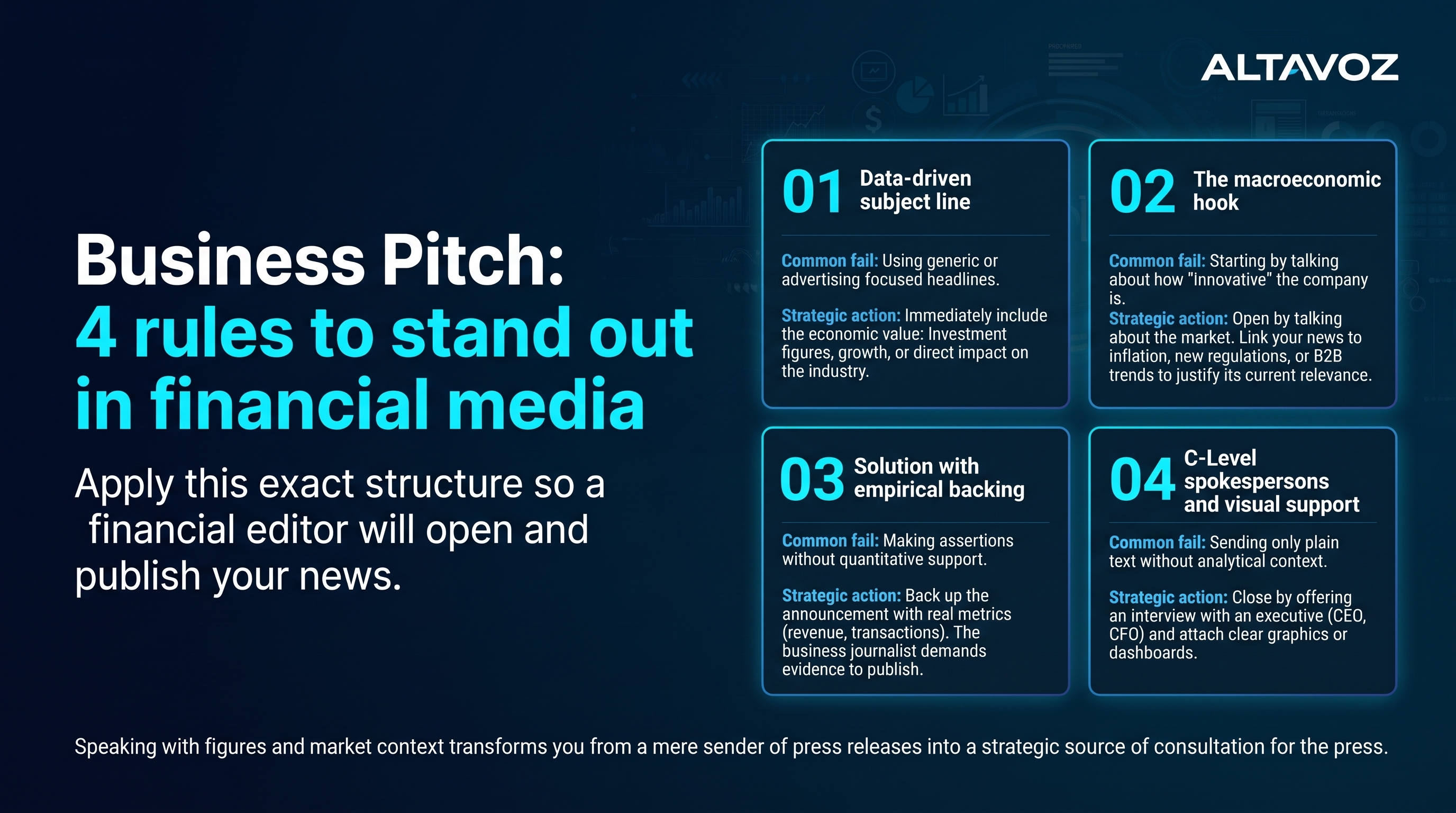
An effective media approach to an economics journalist does not require long introductions or grandiloquent adjectives. It requires precision, market context, and verifiable figures. The exact structure that maximizes the media conversion rate consists of four non-negotiable elements:
1. The Subject Line: Hard Data and Sector Angle
The email headline determines whether the message will be opened. Instead of using generic subjects like "New update to our platform," the pitch must contain the economic value of the news. An effective subject line includes investment figures, growth percentages, or the direct impact on a specific industry. The objective is to indicate right from the inbox that the information carries financial weight.
2. The Macroeconomic Hook (The "Why Now")
The first paragraph of the email body should not talk about the company, but about the market. The corporate news must be linked to a current economic situation: inflation, regulatory changes, supply chain fluctuations, or new B2B consumption habits. By contextualizing the launch within a macroeconomic issue, the temporal relevance of the news for the journalist's agenda is justified.
Request a reputation assessment

3. The Data-Driven Solution
Once the market problem is established, the corporate milestone is presented as the solution or response to that trend. At this point, it is vital to provide metrics dashboards or structured data that support the corporate claim. Financial editors require empirical evidence; statements regarding transaction rates, revenue growth, or the system's technical performance provide the necessary validation to substantiate the article.
4. Availability of a High-Level Spokesperson (Tier 1) and Visual Resources
Economics and finance articles demand analysis and expert opinion. The pitch should close by offering an exclusive interview with a spokesperson possessing financial authority—such as the CEO or Chief Financial Officer (CFO)—capable of delving into the numbers. Furthermore, professional graphic material must be attached or linked, such as clear financial summaries or analytical interfaces that complement the information visually.
Institutionalizing Narrative Precision
Success in financial public relations is not the product of chance, but of the methodological structuring of information. Approaching the specialized press with a pitch focused on economic impact, backed by solid metrics and environmental analysis, transforms the company from a mere issuer of press releases into a strategic consulting source.
At Altavoz Comunicaciones, corporate companies, technology startups, and B2B sector leaders are assisted in the design of results-oriented public relations strategies. Through precise narratives and a deep understanding of the media agenda, organizations are helped to position their messages on the most authoritative platforms.